

All right people,
This day has been a long time coming, a new video is dropping today. Watch the premiere together with me and fellow ferrets here at 20:00 CEST (16:00 Rio, 7PM London, 12PM San Francisco, 00:00 IST).
After the premiere I’ll be hosting a chill live stream (with likely horrifying technical issues), so stick around after the premiere - YouTube will forward you automatically:
Untutorial: Recreating Hans Rosling's famous data visualization using Observable Framework
The Health And Wealth of Nations
As I’ve talked about before, this one is a trial-by-fire, a gauntlet for yourself, an Untutorial to throw yourself into the deep end of getting into data development, by implementing one of the most famous visualizations of all time, and arguably the dataviz that made TED what it is today - The Health Of Wealth of Nations.
The original on youtube (you can also find a better quality version on Ted.com)

For some of you, you are already past this point, and then the video might do nothing for you, but otherwise, I hope that this can be what you need to jump off the cliff into the cold water, showing your skeptical neurology that this is indeed well within your abilities, moving data development from a maybe to a been-there-done-that.

The Untutorial experiment
Having focused on the release of this video this week, I have absolutely zero, zilch energy to write the normal chronicle, but I can talk a little bit about the background and reasoning about this particular video, a behind the scenes, behind the mind, if you will.
The Untutorial is a new intentionally highly experimental format and deviates a lot from the old FFF formats, and there are many facets of this particular production that I will keep and many that I will change, so don’t hold back on the feedback.
The fear of the baseline
YouTube has changed quite a bit since I started 8 years ago, or whenever it was. It is ridiculously hard to re-start something - first time for yours truly, I realize in hindsight, I’ve only ever started new things, perpetually, which is a creative kevlar of sorts, because comparing yourself to yourself and what you should be now is a very uncomfortable proposition. If you are just doing new things all the time, the point of reference disappears.
In a way, it is like a time series plot without a baseline to compare with. If you just launch a completely new product every year, then you cannot compare the sales to last year. Doing apples and oranges and pears protects you from self-inspection, to see if you are truly growing, or just creating the illusion of it, by moving horizontally.
What is the distinction between
generating and genuine creation?
I have been thinking a lot about how to position myself as a content creator / author / intellectual professional, in an age where production capabilities become so much easily accessible. There is just so much material out there, and more is being generated every day, by humans, and to a greater extent assisted by generative AI.
In such an age of abundance of derived information and content, what creative skills should be honing?
1. Modeling
As developers, I’ve already mentioned in the Dawn of The Data Developer that Modeling is what I consider to be the core skill of a developer, i.e. figuring out exactly what to tell the computer (and then adapting and maintaining the integrity and quality of that model over time, in collaboration with other programmers and stakeholders).
Coding has always been, and still is, a very small part of a senior developers job. This doesn’t mean that LLMs won’t cause issues, as junior devs can to a large degree be replaced with LLMs, so we might be seeing problems with the inflow of engineers - how would someone actually grow to senior if there are no junior jobs? We might end up in situations similar to NASA, where, after the Apollo era, the lack of new engineers learning from experienced ones led to a loss of expertise in lunar missions. When it was time to return to the Moon, they had to rebuild this capability from scratch because the knowledge hadn’t been passed down to a new generation.
But even in that hypothetical scenario, my hypothesis that modeling is going to be a valuable skill in the future is even truer, since it will be even harder skill to acquire without the junior dev positions that teaches modeling incidentally to people.
2. Discernment
Modeling, in turn, requires discernment. By discernment, I mean the essence in you that determines quality - your taste. What is good code? What is good writing? What is a good bottle of wine? What is good keyboard?
Yes, one can make a kind of checklist, or scoring system to answer these questions, it can only really tell if something adheres to that scoring system we just created. Like how a map of a city doesn’t really describe how the city actually looks and feels, a scoring system can only be a very simplified facsimile of quality. Yes, we can have static analysis of code, and classification systems of wine, but it doesn’t capture the essence of these things any more than google maps captures the essence of Brooklyn, New York.
For this, we rely of experts, connoisseurs, tastemakers. However, somewhere along the line this got quite messed up - a torrent of content and personalized algorithms provides us with a sea of advice, information, products, possibilities.
One area of articles that I find reaches me on YouTube a lot is "advice". I have certainly been guilty of generating many of these myself with my musings, but I can't help but think about a quality problem with these - how do we tell if advice is actually good or not? After all, it's not like recommendation algorithms go out in the world and try out life advice and only then pushes it to people. It only checks if the video is liked, shared and viewed.
I was randomly watching two videos by Mark Manson (the guy who wrote the Subtle Art of Not Giving a F*ck) the other day, and was quite amused that he posted one video praising journaling and dumping on therapy 6 months ago, and then 2 months after that one he posted another video that does a 180 and pushes therapy.
The videos are incredibly well produced from a videography standpoint, but as you might guess from the rather wild delta on something such as therapy from month to month, you might not be surprised to see that this is the level of advice in the videos:
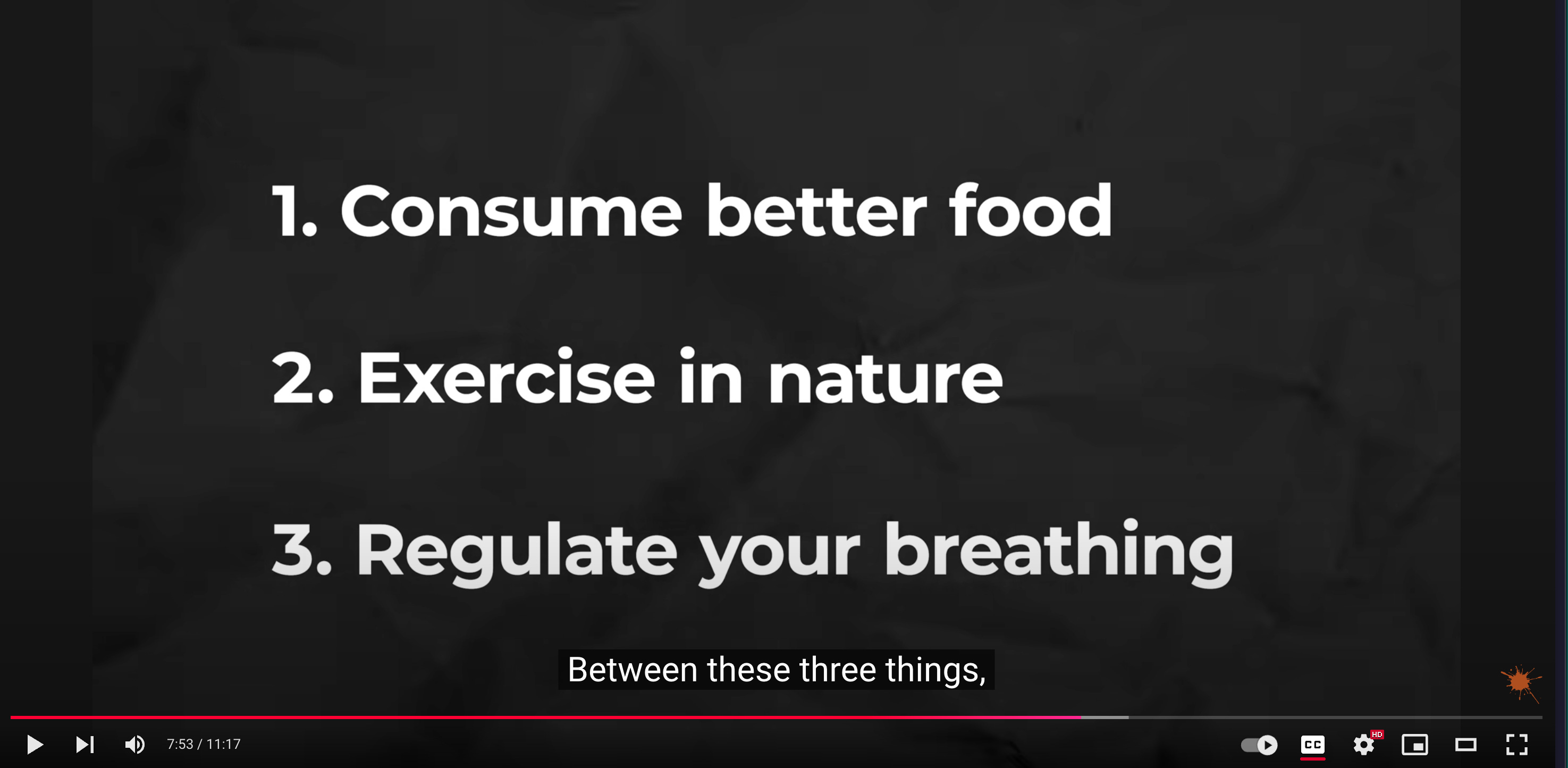
You might also not be completely unsurprised that one of these videos is sponsored by Day One, and one of the videos is sponsored by Betterhelp. 😉
Now, I don't want to shit too much on this - I know friends that have had the Subtle Art of not Giving a F*ck help them in their life, it is an evocative book and narrative that can certainly be useful - sometimes we just need someone like Yogi Bryan to pull us out of a state, so I am not saying that it's bad that this is spread, but it is concerning that we don't really need much substance for things to spread.
This spreads because it is algorithm gold, and most likely the people involved in the production are avid fans of Made to Stick. It feels good, it sounds good, it spreads good. Mark is VERY punchy. It’s excellent production.
How do we tell if someone truly has good discernment, or has he just found things that sound acceptable to a broad base and lumped them in a ball?
I am not too familiar with him, so I can't tell broadly, but he says in one of the videos that "verbalizing your anxieties makes them lose power over you" in relation to therapy - as a person who has spent lots of time in therapy, hundreds of hours of yoga and breathwork and by now close to a thousand+ of hours in meditation, I can at best call that statement lacking in nuance and quite honestly borderline damaging and irresponsible. It is known that merely verbalizing anxieties vents them, but they generally come back if you don't deal with them.
It is a lot harder to find people that have actual, strong discernment of what ACTUALLY works for things (and not just listing 22 things that sounds like they will work). And, ironically, to find them in the first place, you need discernment yourself. You cannot rely of personalization to find quality material, because algorithms have no way to filtering for quality - they filter to engage you, and that it does by showing your material that is agreeable to you.
3. Authenticity
Strong discernment, in turn, comes from a strong authenticity. By that, I refer to the skill of being true to oneself. Finding out what it is that YOU like, and for good reasons.
Eating something because you truly like it, buying a record because you like it in your soul, buying keycaps because you have discerned that particular clicky-clacky sound that you love (but your colleagues hate).
The thing about quality is that it is, in the end, subjective - we do not operate in a conceptual reality, we live in the actual world, where there is physics and individual context and preferentially - quality arises in the moment of experience, and it a wonderfully ephemeral quality that is one the the essentials of being human.
As David Deutsch, the inventor of the Quantum Computer, points out about AGI - discernment is something that AI will only be able to do if it has autonomous experience (i.e. not enforced robot laws etc, how would an intelligence be able to know how to make the laws in the first place, or know their goodness, if it cannot be allowed to experience the learnings behind them) - discernment can only be built by experiencing the world with agency (and this is why we are so far from AGI, it is more of a liberty problem than a technical one).
The book Zen and the art of Motorcycle maintenance deals with the subject of quality in great detail - a book I thoroughly recommend giving a read (and should probably revisit by now, was 20 years since my last read through)
4. Curiosity
Authenticity, in turn, requires curiosity. Being genuinely interested in the world, not ever thinking that you are right (because then you are not being scientific, as Karl Popper teaches us), never being to sure of yourself, and disciplining yourself to see the interesting in new situations. This sometimes requires a large amount of abandonment, courage to see uncomfortable mistakes one has made, and a willingness to be wrong all the time, and, if you are a creator, making those mistakes in public.
If you do not have curiosity - your authenticity cannot be robust, only through curious conjecture can we have a strong authenticity. Without authenticity, our discernment is just strong, but not deep and will be moving unpredictably around depending on the whims of the situation, hype or sponsors,
Anyway, pulling modeling, discernment, authenticity and curiosity together, allows us to express ourselves, producing material that is truly discerning models of reality, based on actual broad experience, communicated from a point of authenticity, because we as authors believe what we are saying, with good authority, and not something we communicate because it is what agreeable and rewarded to communicate.
The Augur, The Ought
I guess that this is my very long-winded way of saying that I hope that I can provide you with a strong spark - a jolt that inspires you to move forward in a way that you truly ought to do.
A jolt that is convincing not because of my flair (though I hope I have panache and humor too), but because you see that I it comes from a tremendous amount of thought and curious wandering, that I say this because this is something I believe you and more people ought to learn.
I truly believe that the world is suffering from deficiency of quality truth, and it will get worse before it gets better. I hope that today can be a day where I say what I think ought to be done, and that you join me in making that ought, your ought, our ought.
To survive and thrive we must collaborate. We cannot collaborate without truth and clarity. To have truth and clarity, data must win over the anecdotes.
To surmount the anecdotes, data ought be made elegant and delightful, charming and accessible, beautiful and democratized, authentic and sharp.
That is what I think we ought to do.
Stay Curious.