

Good Monday Morning
This is going to be a quick one because I am off for the weekend for some disconnection. Doing some volunteering at my Vipassana center, I hope for some hardcore dishwashing. I'm not volunteering due to altruistic principle, it's more because serving at a Vipassana center is an incredibly effective way to disconnect and touch grass.
My career becomes more abstract every year, it feels, and working with data and software makes concrete physical things a rare treasure for me, and big kitchen dishwashers are VERY satisfying monsters to use: Dish Pigs on Youtube: "The craziest are always going to be in the dish pit)
👆 It's like this, except interrupted with intermittent gongs and you go into deep mediation for an hour. It's awesome.
I also happen to have an amazing life partner that notices early signs of me becoming too headsy and dissociated and kicks nudges me to go away to the center.
Aaaahnywayyyyy
The topic of today is going to be burnout, but not the one that we commonly talk about - the traditional being overworked/overwhelmed.
I am instead talking about the burnout that is caused by following your passions too little, pouring to little midnight oil on the firesoul, neglecting to burn the candle at any end.
When your creative spirit burns out, not because it is burning too hot, but because you have been so afraid of burnout that you've not put wood on the fire in the first place.
But before we get into that, some announcements!
MPJ hosting more Flow Clubs this week!
Hosting Flow Clubs last week was a resounding success, it was REALLY nice to virtually meet you and get stuff done together, so I am going to do a few more this week!

📆 See schedule in
your local timezone here: fff.dev/flowclub
(using that link also gets you 30% off and an extended 14-day trial if you use code MPJ30 at checkout)
🥫Same time slots (mon, wed, fri) as last week, however new format: Last week I did pomodoro-style flows (25+25+25), but it did feel a bit too broken up, so this week I am trying long 90-minute uninterrupted focus sessions, but with a little bit more time at the checkin and checkout - let me know how you like it.
Production update: 8k resolution in 120FPS?

The saga of the charmingly bohemian content creator MPJ telling the extremely patient marketing team of CodeCrafters "oh the episode you sponsored episode is SURELY coming next week!" continues. 😊🤣🙏 Best most patient sponsor evar 💛
And I swear to you too, dear readers, the episode is actually getting there! To make the wait more bearable (and maybe more exciting) I can give a little glimpse into what a vector-based production process gives you.
As I've touched on before, one core bet with the new format is to go script+voiceover+animation first, and have the animation programmatically generated by feeding the episode (type)manuscript to Motion Canvas.
One of the cool aspects of doing things in Motion Canvas is that it is all vector graphics, rendered to HTML5 canvas, which is a very performant way of working - it is blazingly fast compared to something like After Effects.
When working, you drop to 1/2 resolution to have snappy realtime renderuing, but when you want to render the material out (which it elegantly does as a PNG sequence that I stitch together with Compressor) you can simply double the resolution. This is a kind of wild thing when you are used to working in animation software that is pixel based.
And since Motion Canvas doesn't work with keyframes either - yes, it quite literally doesn't have the concept of frames - you can just CHOOSE what the FPS is at output.
And I figured... Why not just render at some crazy future quality, that becomes BETTER as displays improve? Not sure if I'll actually do this, but it is a fun thing to show off to indicate the power that lies in this way of production.
Below is a few seconds of an 8k export in 120fps (youtube sadly only shows 60fps currently) just to show how smoooooth the animation becomes.
8K 120FPS Untutorial Motion Canvas Test (Video)


Advice Column: How do I make time for my side project without burning out?
I was struggling with inspiration for this chronicle and a reliable buster for that is always to check what you wonderful peeps have written in, and this one by Kevin struck inspired me:
Hi MPJ
I have a personal project idea with a very large scope. It's been evolving and building upon itself for years in my brain (in a good way, I believe and hope). I very much love it as a unique idea that I think would be good for me and the world if I ever produce even half of my plans related to it.
I won't get into the details of the idea itself. But it's a highly interactive tool, which is well suited to a web browser implementation using JS. I think Solid is the right tool for the UI and have been learning about it and making a proof of concept of the project/tool.
[...]
How will I continue to chip away at my project idea?
I look forward to learning more about JS, Solid, and Motion Canvas [...] But aside from my internship where I learned JS+React, and a short couple months on a project at my permanent dev job updating a JS+React product, I have for the most part been learning and loving JS in my free time.
It feels like classic golden handcuffs at my high paying tech job: I am reasonably happy with my pay and the domain I work in, but I rarely get to use and learn the tooling that I _want_ to be an expert at. My personal life is also very large now with travel, getting married and buying a house this year, and no signs of letting up next year when we start renovating the house and continuing travel.
I also am neurodivergent and undiagnosed for ADHD/autism/etc. So I appreciate you sharing your experience and tips related to that. This week I've been meditating on and practicing "going with the flow" more often (e.g. getting up and writing this at 4am when the idea strikes) and have been having focused and novel experiences because of it but I'm worried about burn out from working my brain too hard.
So steering the giant ship that is my life now to go on this grand project-idea adventure in JS-land seems like a pipe dream.
Do you have any advice?
Best,
Kevin from Seattle

Hey Kevin
There are a couple of things I want to touch on here.
First of all, it is really important to think about what it is that you actually want here, and what you need.
The first thing that I want to touch on is the most important one - if you have a creative demon in your soul, it must be fed, at least to some degree, or it will at best bother you and at worst hurt you. And this idea doesn't leave you, evidently - you need to do something about this.
Being a creative soul means that you don't really have a choice on some matters. There are some things you need to make time for, or you won't be happy.
I remember that there was some sword in the D&D rules when I was a kid that when it was drawn had to taste blood within a certain time or it would consume yours - I think of creativity a bit like that. You have to make time for it, and it will provide for you, but if it doesn't it will rip at your insides, and the more you suppress it, the weirder the kickback will be.
There are problems that I see in your email, which I'll get to, but burnout is probably not the problem you'll be facing. I think you are more likely to be burned out if you don't do something about this - it is interesting to read up on Eudamonia (The neural correlates of hedonic and eudaimonic happiness: An fMRI study) and and the different kinds of burnout (WebMD).
Positioning yourself in a situations where you "objectively should" be happy while suppressing an important creative expression is one way that will sap your soul in a very subtle way and will be hard to spot and repair once it has taken hold of you.
I find that many people have an impression of burnout that the problem is "too fast of a burn" which is certainly a problem sometimes, but most common reason a fire burns out is plainly that it doesn't get enough oxygen and fuel. I.e. creative suffocation or starvation.

It is a bit unclear if what you are intending to build is a business or not. If it is a service that you intend to offer to world commercially, then I really need to give you some tough love.
I would challenge you and say that a "personal project with very large scope" is an oxymoron. A project with a "very large" scope is never personal - it pulls in people around you, your wife, family, friends, investors, creates employees etc. If it really CAN be done by one person (and isn't just delusions of grandeur), it's not a very large project in the grand scheme of things.
I am going to assume that this is actually large, and drop the pretenses of this being a personal project. It's just a project.
You need to ask yourself, do you want to do this, or do you just want to have done it? I am later also going to ask you - do you want it done? These are three extremely different desires.
A commercial product is a massive undertaking, even a small one. Getting something that is even a mint-sized business off the ground requires budgeting 2-5 years of concerted effort from yourself. You'll need significant support from the people around you, and generally requires putting most of your life on hold. It needs to be something that is worth that, if you are planning to put it into fruition.
If you are looking to create a business (that isn't explicitly a lifestyle-supporting business, and this one doesn't sound like it) and you yourself are to be the creator, and the business holder, then no, sorry, you can't be spending energy, time and money on muggler trivialities like travel, marriage and mortgages. Sorry.
You need to be willing to give this YEARS of your LIFE, not some paltry hours here and there. Below is a video that shows you the kind of people you need to be willing to be:
My Wife and I Made an Indie Game and it Made Millions!
These peeps did not travel around the world, they sat inside and made a game for years. Think about if this is what you want, and if it is, adjust your plans accordingly.
I'm not saying that you can't have a life if you're doing a business, but if going into it, you need to be okay with the idea that you might not have one for a bit.
If this is not the scope you intend, that doesn't mean you should give up on the idea, but you might want to ask yourself - do you need to OWN what you create? Do you actually need to complete the project in question? Do you want the world to have it, or do you want to have it?
It it enough for you to have it exist in the world, birth it, be the spark, start the movement? Can you let your ego go, and trust the world to take it on?

If you are open to that line of thinking, things are much brighter - and you just might create something much larger than you could have ever imagined in your original idea.
Linus Torvalds developed the first version of Git in about 10 days. He started the project on April 3, 2005, and by April 14, he had released the initial version. Git was created in response to the need for a distributed version control system for the Linux kernel after the project ceased using BitKeeper, the proprietary system they had been relying on.
Sometimes you don't need to make it perfect, or complete it, you just need to make a really hard mic drop.
haha this was not the plan at all but just realized that I can mention here that CodeCrafters has an interactive challenge where you learn to build your own Git OH MY GOD I AM THE BEST AT SPONSOR SEGUEWAYS AREN'T I
It is maybe not a coincidence that Brendan Eich made the first functional prototype of JavaScript in 10 days.
Twitters first prototype was also cited as a 10-day project, as well as the internal prototype at Apple for the iOS App store.
A lot of times, I've seen incredibly impressive ideas put forward by genius people in conceptual presentations, beta software, just to inspire a movement.
One old video that comes to mind is Bret Victors INSANELY incredible talk Inventing on Principle (embedded below). This video is 12 years old now and is one of my favourite gems - is certainly a lot of work put into what he shows, and it is incredible displays of vision. But making any of these ideas reality (and many of them are real now) would require not hundreds, not thousands, but tens of thousands of hours of human labour to put into reality.
THAT is a very large scope, and very large requires not a person, but a movement.
Inventing On Principle by Bret Victor:

Another example (that might very well have been inspired by Bret Victor) is Dan Abramovs initial presentation of Redux at React Europe in 2015 - this was groundbreaking at the time and truly shifted how the entire field thought about data flows - Redux was really not a huge project, but it was a small, surgical tool that was very well presented and conveyed a grander idea.
Ask yourself, do you need to be the one that makes this, or is it okay of you generate the spark? Is expression enough, is manifesting enough? To what degree must you have control? Must you have it at all?
Can you make a 10-day-seed of hope and dare drop it into the earth?
Can you let it go, and just let it rip?
The Continuity of Splines by Freya Holmer
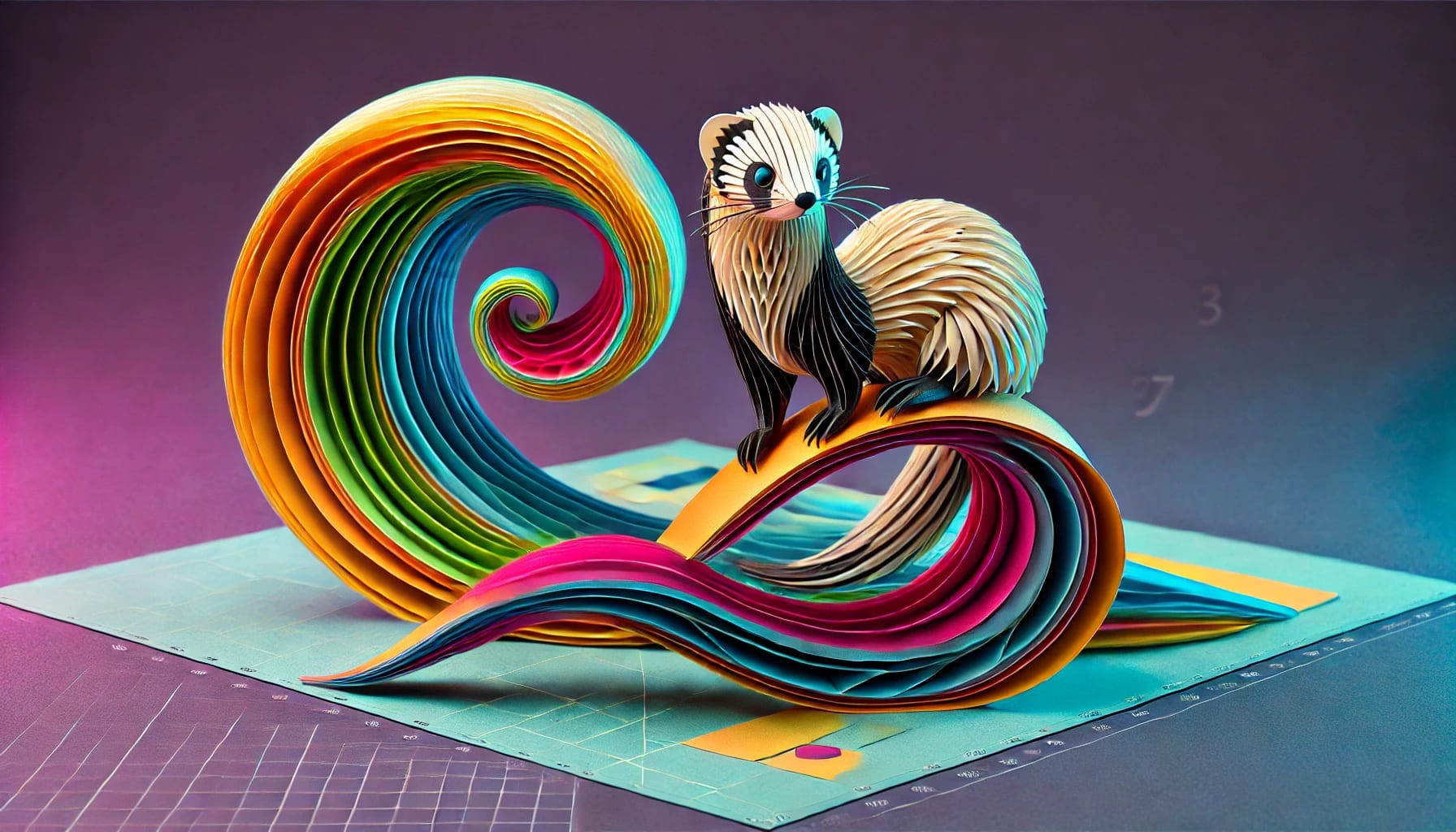
Because I am living my life incorrectly, it has taken my until now to discover Freya Holmér, that makes absolutely breathtaking videos about animation math. If you didn't think bezier curves was your thing, and that math cannot be beautiful, you will change your mind after watching The Continuity of Splines:
This isn't made with Motion Canvas btw, it's made with a custom Unity plugin, Shapes, made by Freya. It's quite funny that what initially motivated Freya to build her (incredible) Unity math animation framework was that she wanted to use C# rather than JavaScript, and that Motion Canvas is built in TypeScript, which is made by the creator of C#, and is, if we are being honest, extraordinarily similar to C#. 🤣
Unnatural abstractions

Speaking of getting side projects done, Peter, a reader of the chronicle, rolled up his sleeves, removed distractions and wrote a short story, that I think some people here will find quite delightful: Unnatural Abstractions
It quite cool to see how creative this community is, and it is really inspiring when you send in your stuff, big and small.
I wish you a delightful week 34

Did you know that on week 34 in 1911 the Mona Lisa was stolen from the Louvre in Paris by some dude that hid it in a storage closet overnight, then simply walked out of the museum with the painting under his coat the next morning?
He laid low for two years before trying to fence it and got caught, and caused a media frenzy over the mystery of what was then just another masterpiece among many at the Louvre.
So, ironically, it was not Da Vinci, but Vincenzo Peruggia, an Italian handyman and amateur art thief, was who made the Mona Lisa truly famous.
Friendly reminder again to book in good time if you want to ensure a place in a flow: Mon, wed, fri - schedule listed here: fff.dev/flowclub
"My asserted frame of dignity is that I should be rested."