


Double video release today!
All right, I'm dropping two videos today! They premiere at 9AM PST / 6PM CEST, if you want to watch the premiere live with me and other FFFers, you can do so here - that first video premiere will automatically redirect to the second video.
You know what they say, a picture says a thousand words, a video says a lot more, but not as much as MPJ talking about two of his videos:
Video 1: Line Plots are Plot Lines - A data visualization spoken word cover of funfun.email #12

It was always a little dream of mine to take the best of the chronicle and make video "covers" of them, but what format that should be was less obvious.
One of my favorite chronicles last year was absolutely #13, the plot lines one, and when I started exploring how a video script for it would be, it just turned more and more poetry the more I worked it, so I decided to lean into the theatrics and let it be over the top, and it was so delightfully fun to make this one, I hope you appreciate it:
Line Plots are Plot Lines - A data visualization spoken word cover of funfun.email #12:
It is common for us to be touched by stories.
Rarely are we touched by digits.
But digits can be turned to line plots
and line plots can express a plot line.
Have you ever attended a spellbinding budget meeting?
I have.
It was at a meditation center board meeting.
I have been in many budget meetings in my life,
and they are usually dominated
by tables of numbers,
profit and loss statements,
revenue at the end of this quarter or that.
I also expect the audience to
covertly simulate
not zoning out.
This meeting was different.
The treasurer enthralled the audience - iconoclastically eschewing tables of digits and instead presented the metrics as time series,
plotted on a line,
line plots,
plot lines,
telling the story of how donations flowed to the center every year,
more in the summers,
and how liquidity increased after the summer due to a loan taken,
and how that liquidity was spent
buying materials for the construction
of a new meditation hall.
Line plots can captivate!
To survive and thrive,
we must collaborate,
and to collaborate,
we need truth and clarity.
But our world suffers a deficiency of quality truth.
Instead of speaking data,
we shout
pluralities of anecdotes.
An anecdote
is one point
told as a story,
and thus anecdotes enjoy
the privilege,
the prerogative,
the endowment
of story.
So anecdotes ascended to authority
dominating data
dubiously,
disproportionately.
How could a
nuanced
neutral
numerical
narrative possibly compete
with fiery fables of
feasting cats and dogs?
The digital revolution is new -
we only needed to start digit-
izing when we invented pottery,
merely 12,000 years ago.
In contrast, we've had stories for millions of years.
Stories are
primeval,
primordial,
visceral,
natural.
Pottery may be new technology,
but lines are not.
Developmental psychology studies show that
young children understand
time or progression
when they are presented
with a timeline or a path of dots.
Why is that? Perhaps lines even predate stories. One can imagine communication, prior to spoken language, our ancestors pointing and drawing lines in the sand, to plan hunting, making maps.
Line plot or plot line,
both come from the old English plot,
meaning a small piece of land
and, by the 16th century, the age of Shakespeare,
the word evolved to describe
a plan or scheme,
a mapping of events
in a narrative,
guiding audiences through a structured sequence.
When we plot a story or a time series,
we are mapping meaning onto time or space,
showing relationships and progressions.
Just as land plots are markers of territory,
story plots chart emotional landscapes.
Each plot point is a landmark in the journey
across the terrain,
whether that terrain is land,
the psyche,
server uptime
or a budget.
We turn numbers into lines,
digits into paths,
snapshots into flowing time,
plotting lines
so that we also, viscerally, understand -
not merely our System 2.

Video 2: From Physics to AI: Building a 200ms Coding Assistant | ft. Guy Gur-Ari, co-founder of Augment Code
The coding assistant / Developer AI that I've been using personally for the last few months now has been Augment Code, and I'm very happy to announce that we have an official partnership, something that I wanted to make happen immediately after I started using it.
Please do let them know I sent you, by signing up using this link, it helps support FFF out a lot:
...aaand the video:
From Physics to AI: Building a 200ms Coding Assistant | ft. Guy Gur-Ari, co-founder of Augment Code
The video focuses on the narrative of how Augment Code is uniquely good at handling full codebase awareness for codebases of actual-workplace-size (and much larger too) at extremely low latencies for an LLM solution.
But if you are interested in some of my personal thoughts that didn't make the video, about choosing a coding assistant, read on:
I have been rather silent about my personal coding assistant use, because quite honestly I never found one to be quite good enough to warrant downsides of adding an assistant to my workflow. Don't get me wrong here, I think many assistants out there are good, they just aren't good ENOUGH - for me.
I'm perhaps a bit atypical so let me explain where I am coming from so that you can determine if this is relevant to you too.
I am a recovering tooling alcoholic (I realized that I had a problem around the era when ReSharper was a thing) and my attitude to these things is expressed in this video by much younger version of myself:
I don't like introducing too many things into my workflow, and when I do, I want it to be something that I can use for years and years and learn to use like a fine chefs knife, and be loyal to that brand. For me, dev tools are sort of like cameras, switching brand becomes a big thing because you just build it into your neurology a bit if you really lean into a tool.
Pretty much all developer AI solutions are cloud-based which means that you are introducing a network dependency into your toolchain, which means that you will have to change habits completely if you jump on a plane, or if you are out on the country with spotty wifi (which is for me quite often when I do an offsite retreat to focus on getting some project out the door).
I think this is worth it for Augment Code, but for me, Augment is the first assistant that was good enough to offset this downside. In this over-connected, over-distractable world, I really, really like to be able work offline if possible, it was a big decision to start depending on an LLM for me. Just the possibility of a network request failing means my flow is highly likely to be broken.
I know, I know, theoretically one can fall back to non-AI habits if a network connection is spotty, but I am not like that. Personally, I find that I am most productive when I lean into tools so heavily that the hotkeys are fused into my bloody spine. I want to focus on the problem I am working on, not the meta of the tool - that should just be an extension of myself, and be as simple and robust as possible.

Paying for capacity
I really like that Augment is priced... how do I put this... plausibly?
It is the best and most reliable assistants I've found, but it's also premium priced - at $30 for the individual license, and $60 for enterprise license (isolated env, soc2 etc). Also, when comparing it's important to take note that they charge per ACTIVE user i.e. if a dev is on vacation for a month, Augment won't bill your account.
$30 is an interesting price point - and there is only really one other software that charges that much, that I also happily pay for, and it's Superhuman. $30 is a magical price point that many companies avoid because it means you need to be able to withstand a tremendous amount of scrutiny compared to a $20 price point.
When I am considering tooling for my core professional workflows, I really really dislike to use products that are free or suspiciously cheap. I want what I pay to matter somewhat to the company that produces my dependency.
Considering that you can get an okay car for less than the more expensive Nvidia GPUs, the pricing strategies of many of the established actors has always seemed a bit fishy to me. Copilot was extremely suspiciously priced at $10 when it came out and Microsoft's GitHub Copilot Loses $20 a Month Per User.

I first heard the saying "if you're not paying for the product, you are the product" about Facebook around the time of the Cambridge Analytica debacle [Wikipedia], but that quote was actually originally about television advertising in the 1970's, and it's a truism that I think works well when it comes to AI too.
But for me, this is actually not so much about data security as it is about reliability:
For my non-coding, non-developer work, writing video scripts, copywriting, brainstorming etc, I tend to mostly rely on Claude, but I switch around a bit too. Especially when using GPT, the failing it is especially obvious that they are not having much spare capacity sitting around and it is very obvious that I am sharing the processing capacity with others with very little margin for capacity swings.
I don't know about you, but my experience trying to develop with a general purpose LLM gives a looooot of this:
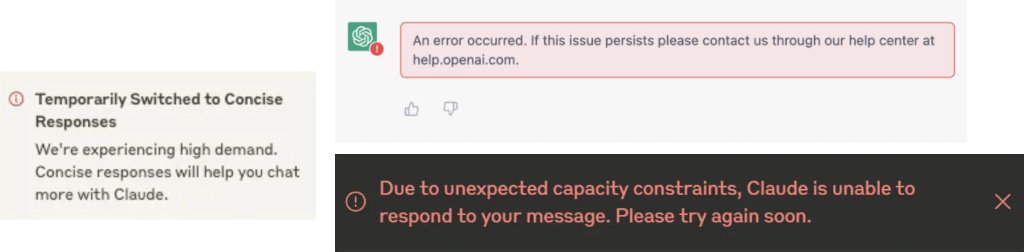
While I am okay with interruptions like this for my personal stuff, and at least somewhat tolerant for it when I am doing professional creative writing, my developer time is more expensive.
If I am billing a client for my own dev time, or if I am paying a license to provide the developers on my team, I absolutely do NOT want interruptions by connection errors due to my provider using a loss-leader capacity strategy.
And don't even get me started on what incantations of murder I would invoke upon an AI provider that breaks down when I am awoken in the middle of the night by PagerDuty to fix a payment system failure.
MPJ is shorter than Michael Jordan

Finally, it's sooooo wonderful to have sponsors like Augment that are willing to be a little crazy with the format.
Me going "um hey, instead of doing the standard sponsored mention can you give me hours with your most technical co-founder to extract a 40-minute deep dive for my audience" and getting an enthusiastic "let's rock" is really cool to be able to do. Big shoutout to Emma, Head of Communications at Augment for making this happen.
I, of course, don't want to compare myself to Michael Jordan (I'm a much better programmer than him, and even if I wasn't, I'm also much shorter and vastly superior to him at traversing tightly cramped spaces such as ventilation ducts) but I was very inspired by the Air movie:
I saw this when I was thinking about what partnerships I wanted for this new generation of FFF - it made me want to really evaluate partnerships more as a retailer looking for the best stuff to resell, rather than someone selling mention space in my videos, and this is the first experiment in this direction.
Onwards into 2025
Thanks for your nerdy interest in this weeks behind-the-scenes-meta chronicle. I am so grateful for having you all around while figuring out what new the FFF is about during last year. It feels like the vision is finally becoming clear, and looking forward to a very active 2025!
And, to be true to the form of a creator, I give you one final nudge with: fff.dev/augment
As always, stay curious 🧐🐒
Mattias Petter Johansson