

I've had the growing realization lately that web devs will have a lot easier time getting into the field of data than I initially thought. I early on concluded that data visualisation was a good place to start for web devs, but a new realization is how incredibly dire the need of sophisticated data visualisers the need is.
The Data Visualization tech has been stagnant (measured in web dev speed)
The fields of data engineering, data analytics and data science are by now mature industry fields, but what has struck me is now incredibly primitive it is when it comes to the "frontend layer" (if one can call it that) - i.e. what is called "data visualisation" but I think what passes for that is not really where it could be if web devs joined the fray and rolled up their sleeves.
It is perfectly acceptable for a data department to have an minor army of engineers and analysts, yet the visualisation and interactive tools that they produce makes me think of what the web was like many years ago, when HTML and CSS were much less sophisticated and any complex apps were boxed into a Macromedia Flash "movie" or a Java Applet.
Don't get me wrong, there ARE certainly tools out there that produce impressive data visualisation, but it's just not the culture to spend time on it. A data org will spend hundreds of thousands of dollar per year to create data pipelines, but it is only recently that it is starting to dawn on organizations that it is a good idea to cultivate the final product a bit.
I generally try to avoid be the guy that brings up Apple success as an analogy for everything, but the reason why Apple is so often referred to is that Apple, not always, but much more than the average company, inspect the state of reality and do what is the effective thing instead of looking for a "best practice".
There were plenty of smartphones prior to the iPhone, and there are many reasons for the success of the iPhone, but in this case I want to focus on the fact that they focused on cohesion in the upper layer of the technology. They put technology together in a sensible, cohesive, and beautiful way. Prior to the iPhone, smartphones existed, but they would be more accurately described as hardware bundles of features rather than what we nowadays think of as a product.
This is where I feel that the field of data is right now. If you remember what we apps were like in the Ruby on Rails days, you know what I am talking about, data apps are at the level CRUD web apps were, not quite cookie cutter but only slightly above it. The individual features and infrastructure is there, but the culture has a woefully unproductive disrespect of final cohesion and a fear of the complexity that adaptation around real user needs entails.
Your uniquely valuable position as a Web Developer
To be fair, web developers have been as uninterested in data as data scientists have been in the web platform. We have been busy building consumer applications, and when they needed graphs we kinda just pretended they didn't really need graphs because while we certainly knew how to draw the geometry, we didn't know much about the underlying data.
When I started out with web dev, there was much more of an apartheid in frontend and backend than it is now - to change an endpoint you would go the backend developer that had a strong culture of beards and vim and time complexity, and would grunt sentences like "a person that calls themselves full stack has never seen a stack". Frameworks like SolidStart that truly blurs the line between backend and frontend was an unthinkable concept just 10 years ago
In a way, it kind of like how newspapers had dedicated typesetters before that process was digitized, but as tooling becomes more powerful and integrated, one person can many more jobs, and specialised jobs are fused into one.
This is what I am referring to when I talk about the Dawn of the Data Developer - data tooling is now becoming so powerful that we can have a full-stack data professional, a single person that can take great and messy data wealths and shape them into form - similar to how a full stack web dev that can build an app from top to bottom. That is an oversimplification of course, I'm of course not trying to say that you can replace a data department with one person - what I am saying is that the evolution of tooling will blur the lines in data similar to how it's been blurred in web development in the last few years.
Console output right next to your code with Console Ninja
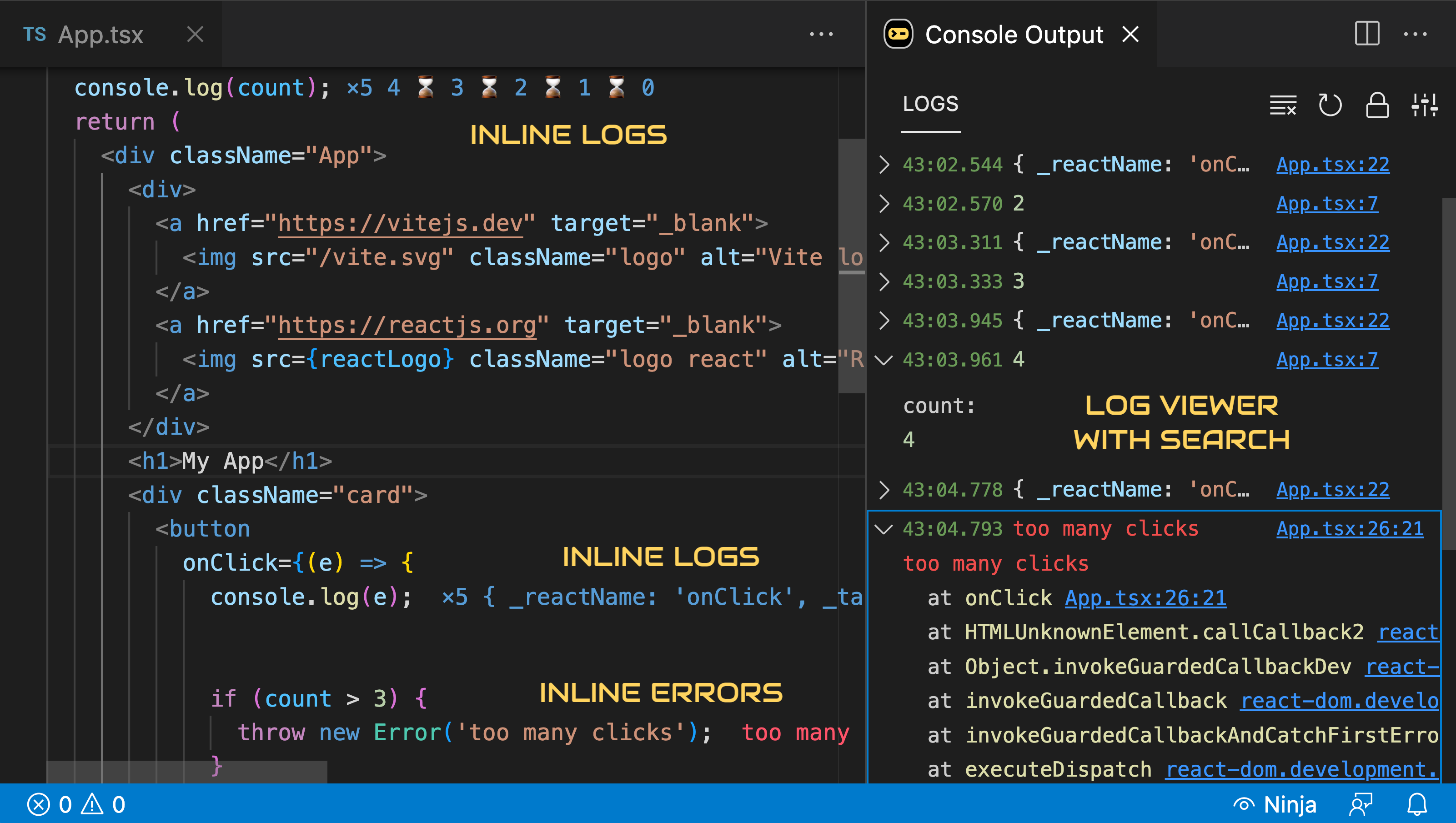
This weeks sponsor is Console Ninja which is the recent developer experience luxury item developed by the lovely Australians at Wallaby.
I discovered Wallaby.js back in 2016 because of my love for unit testing, and I've used Wallaby religiously since. I.e. way before they became a sponsor - it's one of the few plugins I use, and I can't remember another plugin I've ever paid money (both for myself and my teams).
Console Ninja is the latest product by Wallaby, and it is quite an impressive beast. It integrates with hot-reloading build tools like Vite (and tons of others) and slurps errors from the browser into your dev environment, so that you get runtime console.logs and console.errors next to the relevant line of code inline in your editor. 🙀🥰🥳
It cannot be overstated how beneficial shortening the feedback loop and reducing the number unnecessary alt-tabbing to the browser during development is. The reason I've used Wallaby.js and Quokka so much through the years is I can spend more time in my editor and less time in the browser, which really helps me stay more of my time in flow state.
You're worth it.
Wallaby.js, Quokka and Console Ninja are the kind of tool that you don't strictly need, but you still kinda do - they just make development work faster, more flowy and more delightful and it adds up SO MUCH in the end. Give yourself this gift.
💛 So if you want give yourself a some extra luxurious support this week, and support Fun Fun Function at the same time, use our referral link, it helps a lot: fff.dev/console-ninja
Below is also a baby wallaby to encourage you to parent yourself well.
Now, back to the show!

The data front lines will move to frontend
I think that this professional paradigm shift will be led by the people working from the upper layer, the visualisation layer. There is simply isn't much interactivity going on in most data apps, they are rather boring, unengaging and inhuman, even though data is the very opposite of those things when it is visualised properly.

Ah, nostaliga.
In a way, Fun Fun Function, with the Dawn of the Data Developer initiative, is my firm stand that the very process of is not complete when you've written a report, any more than the Palm Treo (that I was a proud owner of) was a complete smartphone. The process of making data truly available to people, is not complete until it is available in an interactive application where the end customer can interact with the data to understand it intuitively, and be touched by it, feel it.
And I believe, that in order for us to get to that point, you reading this, the web dev that is considering throwing your might into data visualisation, you are the key.
I do see some hints at this happening already. the Dawn of the Data Developer is not something I am starting, it is movement that I am seeing happening that I want to accelerate.
Just last week, TheoGG posted a video about ChadCN Charts, which are kind of just the idea that is revolutionary but shouldn't be revolutionary, that a charting lib should be built with the same technical sophistication and attention to aesthetics and ergonomics as a CSS libraries.
How to actually jump into data?
I have received so much mail asking me to just do videos on how to get started, and that is what I am working on, and it's coming. However, it's kind of a moving target, I initially thought that D3.js would be the thing to get into as the base tool to teach, and maybe it still is and will be, but I am reeling in my certainty if it is the best to start, as tooling is now starting to really grow at web engineer speed instead of data engineer speed.
One thing you can do in the mean time is to just get into it and drawing charts, and just pick something - ChadCN Charts is as good place to start as any.

Have a fearless week

One thing that I can tell you for absolute sure, after thinking about this a LOT the last year, is that data visualisation and interactivity is your golden ticket into data if you are an experienced web developer.
The current expectation of Data Reporting will turn into data apps, and anyone that needs to make that MUST have you.
Getting into data will cast you into a world where there are a lot of people that knows a lot of things about statistics and pipelining that is foreign to you, but these same people don't know as single thing about drawing arrows, styling things, state management, render lifecycles, and they are going to be desperate for someone that does, and that is you.
You do not need to get into data.
Data needs you to get into data.
PS. Don't forget to turn into a ninja. DS.