


GMM
This week, I’d like to explore what makes a data story truly engaging. What makes it resonate? While many factors contribute, such as beauty and interactivity, today I want to zoom in on a specific vector: belonging and ranking.
Ugh, do I really have to make my science interesting?
But first, does data really have to be engaging? Doesn’t it speak for itself?
To be honest - I doubt any reasonable data professional genuinely believes data can have an impact without engagement. No information reaches a wide audience unless it’s presented compellingly.
Yet, it seems many in the scientific community act as if a good study speaks for itself. Presentation and impact seem secondary to them. It reminds me of the early startup era when software engineers often assumed, “If you build it, they will come,” and viewed roles like marketers with disdain, dismissing them as mere fluff—even worse than designers.
This attitude—“making my study engaging is someone else’s job”—might explain why our media landscape remains anecdote-driven rather than data-driven. A strong anecdote (a story about a singular event) moves through the news cycle more swiftly than a carefully curated data aggregation.

Though I usually hesitate to bring current events into my discussions, particularly the U.S. election, I stumbled upon a poignant example. During a recent presidential debate, an anecdote about Haitians eating cats and dogs was factually debunked in real-time during the debate, but despite this, the story gained traction, and in the below video clip, JD Vance is challenged on the facts of in the clip below.
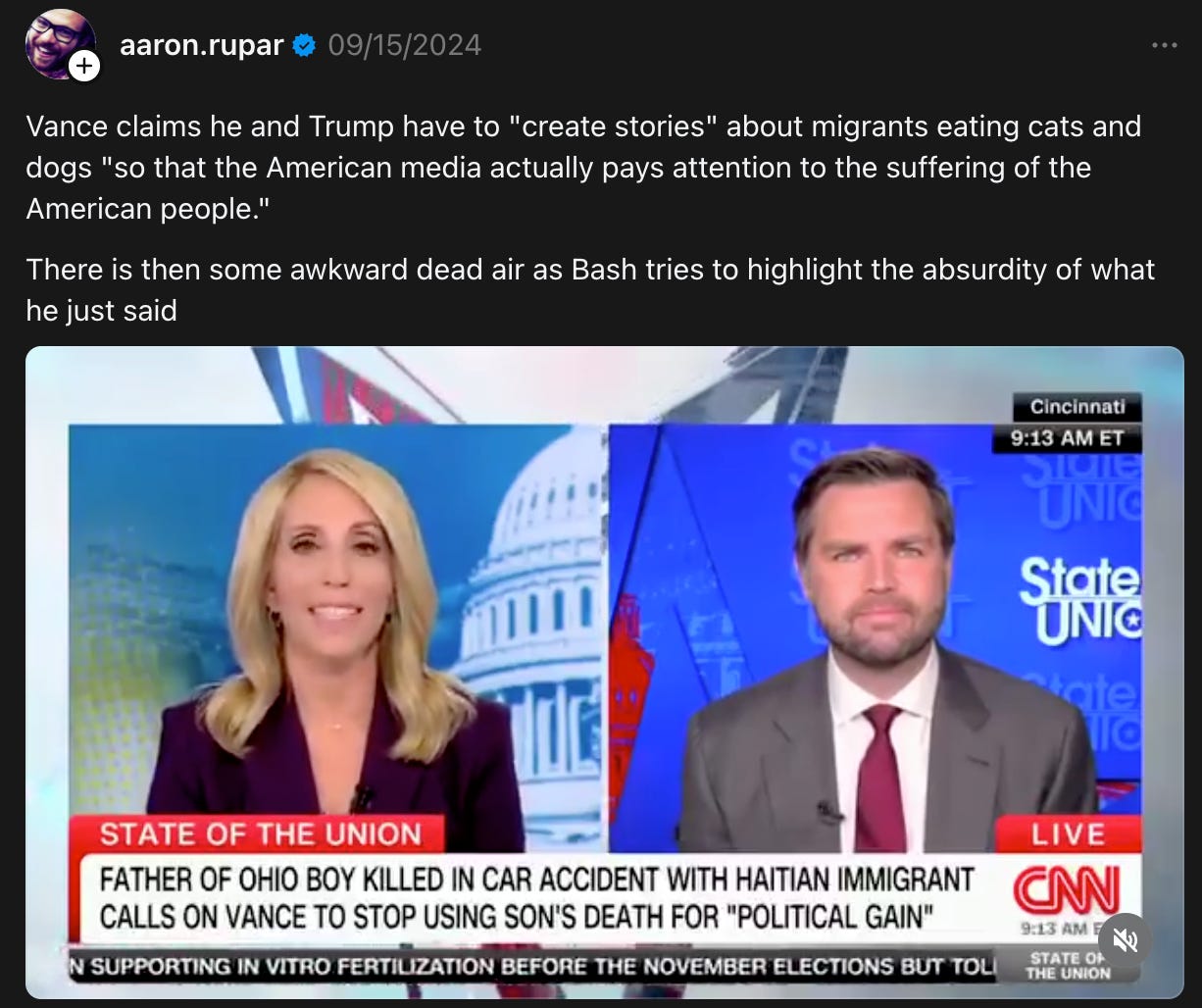
As a Swedish citizen, I don’t follow the U.S. election closely, and this was the first time I actually saw or heard JD Vance. What struck me was his casual admission that this story was crafted to grab attention. If you are interested in the actual background of the actual underlying Springfield story, I found The Daily's audio piece on the matter very nice, but the specifics here are not really relevant to my point, what I want to hone in on here is the role of an anecdote in the abstract.
Watching the clip, as an old forum moderator, it is almost like I am hearing “I need to troll you to get attention because that’s what the system rewards.” and this approach has served JD Vance so well for such a long time that he has realized that doesn’t even need to be covert about it - anecdote-mongering is an effective strategy regardless.

Now, let me clarify: I respect my Republican readers (please hit that reply button btw, I would love to broaden my horizons here) but I should be straight with the fact that my political perspective is shaped by growing up in social-democratic Sweden, which basically looks like communism to the leftmost mainstream U.S. party and or left views the US like the Hunger Games.
Either way, this means that JD Vance is so far from me on the political spectrum that he seems to me like a character from Stargate SG-1 or Doctor Who. Yet, I can’t help but feel a strange respect for his honesty in this instance - there’s something refreshing about a manipulator that is so upfront about his manipulation. I’m sure there’s anecdote-mongering on both sides of the political aisle, and I want to focus on this issue as a universal problem rather than a partisan one - one that stretches beyond politics.
Having moderated online forums, I’ve seen many time how one loud, controversial figure can dominate discussions. In my younger early days, was angry with these individuals, but over time I developed the opinion that it wasn't the individual’s fault as much as the community culture and moderators who enabled and incentivized the behavior.
What's a data developer to do?
So, instead of blaming the anecdote-mongers, the reporters, or the media, let’s turn the lens on ourselves. How can we make data more competitive against the anecdote?
On that note, I’ve explored Threads (if you use it, you can follow me @funfunthreads) with cautious optimism over the last few months. and it seems somewhat conducive to science and data (hope it sticks 🤞). This week, I recently came across this post from the European Commission, based on data from EuroStat (source).
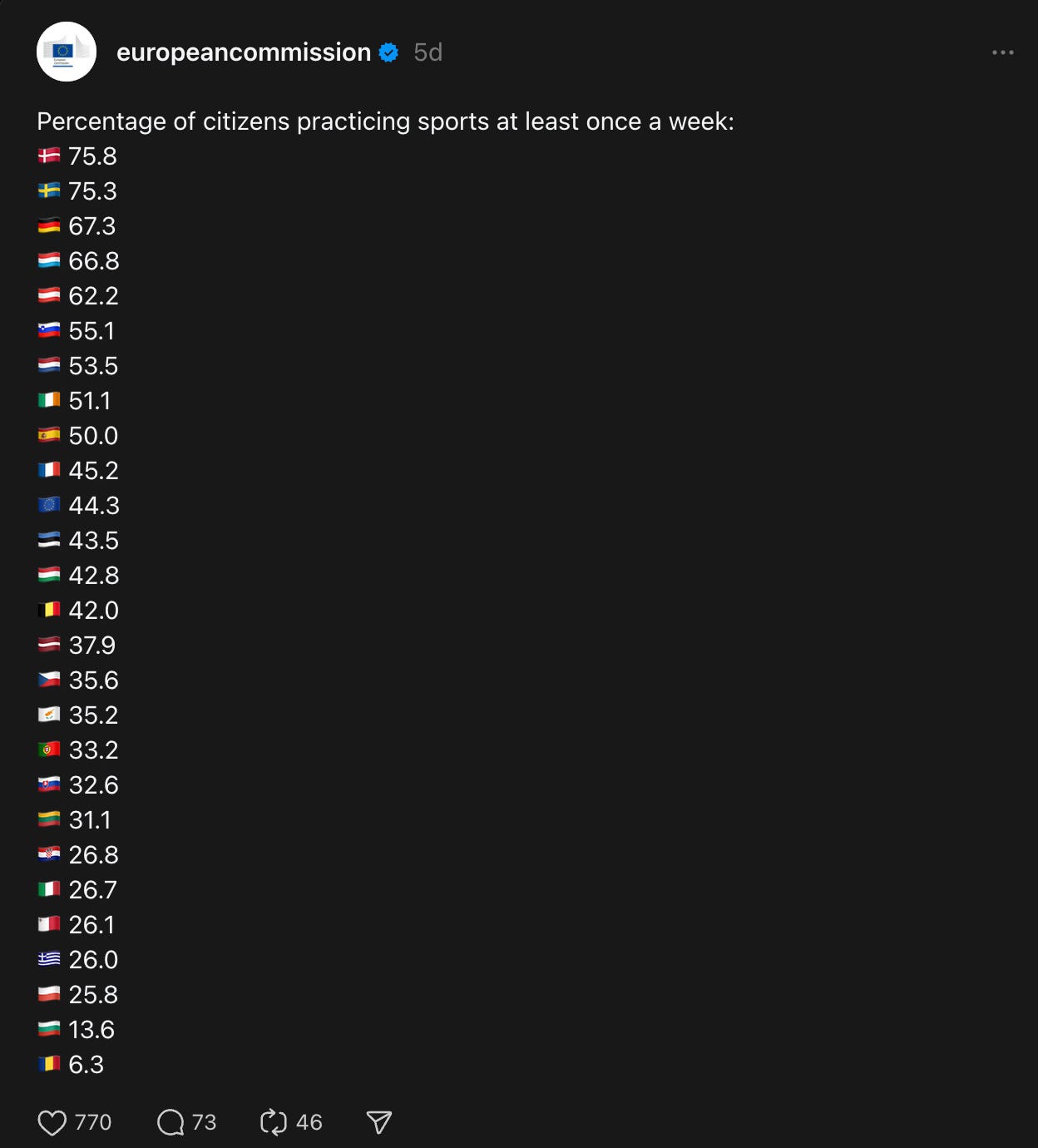
What struck me was how well this post performed. Despite being a pile of numbers, it garnered great engagement. This is, in some strange way, “sexy” data. Whenever this happens, it warrants exploration.
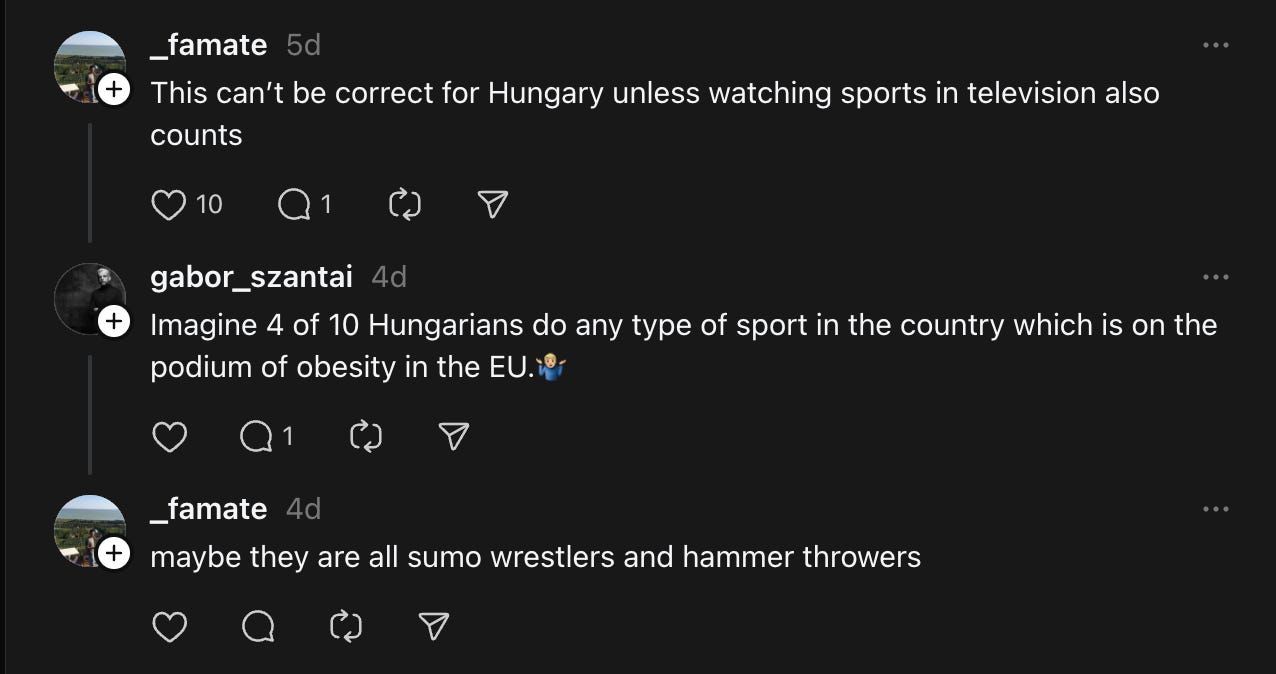
Countries make for perfect data buckets in terms of debate and engagement because people naturally identify with their nationality when faced with such lists - I instantly look for where “I” am in the data. This particular thread even created engagement from groups left out, as demonstrated by the top-liked comment: “Where is Finland?”
Ranking as a Competitive Element
Another engagement factor is the report ranking the groups, pitting them against each other. It’s like a mini Eurovision or Olympic Games, where countries compete, and people engage immediately.

Characters and Identification in Storytelling

In any story, the audience needs characters to identify with. If a viewer can’t locate a perspective from which to engage, they lose interest. This identification doesn’t always mean seeing oneself in the protagonist; we often resonate with villains, side characters, or the struggles of someone in a particular situation. For a story to work, the audience must be able to imagine themselves in someone’s shoes.
What’s fascinating about this little data narrative is that it doesn’t tell a complete story. Instead, it creates a frame for people to fill in their own story.
What does your autumn look like?
Poetry: I hope you had a good week, and that you looking forward to autumn - we hosted a sausage and outdoor poetry reading night this week, a tradition we invented during the pandemic and haven't done in a while. My mainliner was Blackberry Picking by Philip Hobsbaum, to mark the end of summer.
Funny: I can imagine that there might be a group of people that doesn't find Nigel and Marmalade (Shorts) funny, and we can refer to this group as wrong.
Cozy game: I also ran across an incredibly beautiful game that might be a cozy-dark-nights filler in October - Europa (Steam):
If you had anything that tickled your fancy last week that you'd like to share, or ask, data or otherwise, please don't be a stranger, be a pen pal, and hit that reply button 💌
I sometimes takes a while, but I really try to reply to all mail, I love hearing from you.
Be a light, not a judge. Be a model, not a critic.