

Apologies for disappearing.
This chronicle has been the hardest to write so far. Procrastination galore. Not a problem to get started, but constant revisions, insecurities, what do I want to say.
To some degree it’s just shame and disappointment in myself, so perhaps it is important to get that out of the way: To you as a reader, I disappeared off the face of the earth, no notice, no goodbye. I was in the middle of weekly chronicles, a series on d3.js - and suddenly I was just gone. I realize that I’m not the first creator to do this, but I had never done that before - some of you reached out with genuinely caring emails, to which I neglected to respond. I’m sorry. Your caring deserved a better response than silence.
Regardless of whether you think I need to be or not, I am ashamed of dropping out like that. But I was just too broken, too burned out, too many entangled threads, too much stress, too much unresolved practicalities, too much financial troubles and too much accumulated disorder, too many neglected relationships, too much pent up need of rest, too much unexamined time, too much unattended, too many addictions still unbroken.
I am very proud of how far I’ve come in my maturity and self-development, I’ve spent more time in formal meditation over the last 4 years than many do in a lifetime. But what they don’t tell you about enlightenment (if that is what I can call my progress) is that all the actual accumulated entangled realities that have built up over the years are still there, and must still be dealt with. Untangling inner knots is necessary to untangle the outer knots effectively, but the outer knots will still demand time and effort to untangle.
Substack recovery.
If this is reaching you, it means that my migration of your subscription to funfun.email to Substack from customer.io has worked. I had quite elaborate plans to run a massively professional newsletter with personalized ads and stuff with customer.io, in a wonderful sovereignty-fuck-you to the big creator platforms. In reality, I was being arrogant about how much effort I could muster.
Possibly because there have been (several) times in my life where I had the energy and grit to deal with DKIM records and bounce rate optimization alongside figuring out how to make rent next month. To some degree, it’s an I’m-too-old-for-this-shit, but this is more that I have to come to terms with the fact that I am in recovery mode – and it has been made worse because I have been denying recovery to myself for so long.
So very, very long.
The Return of Fun Fun Function was doomed from the start.
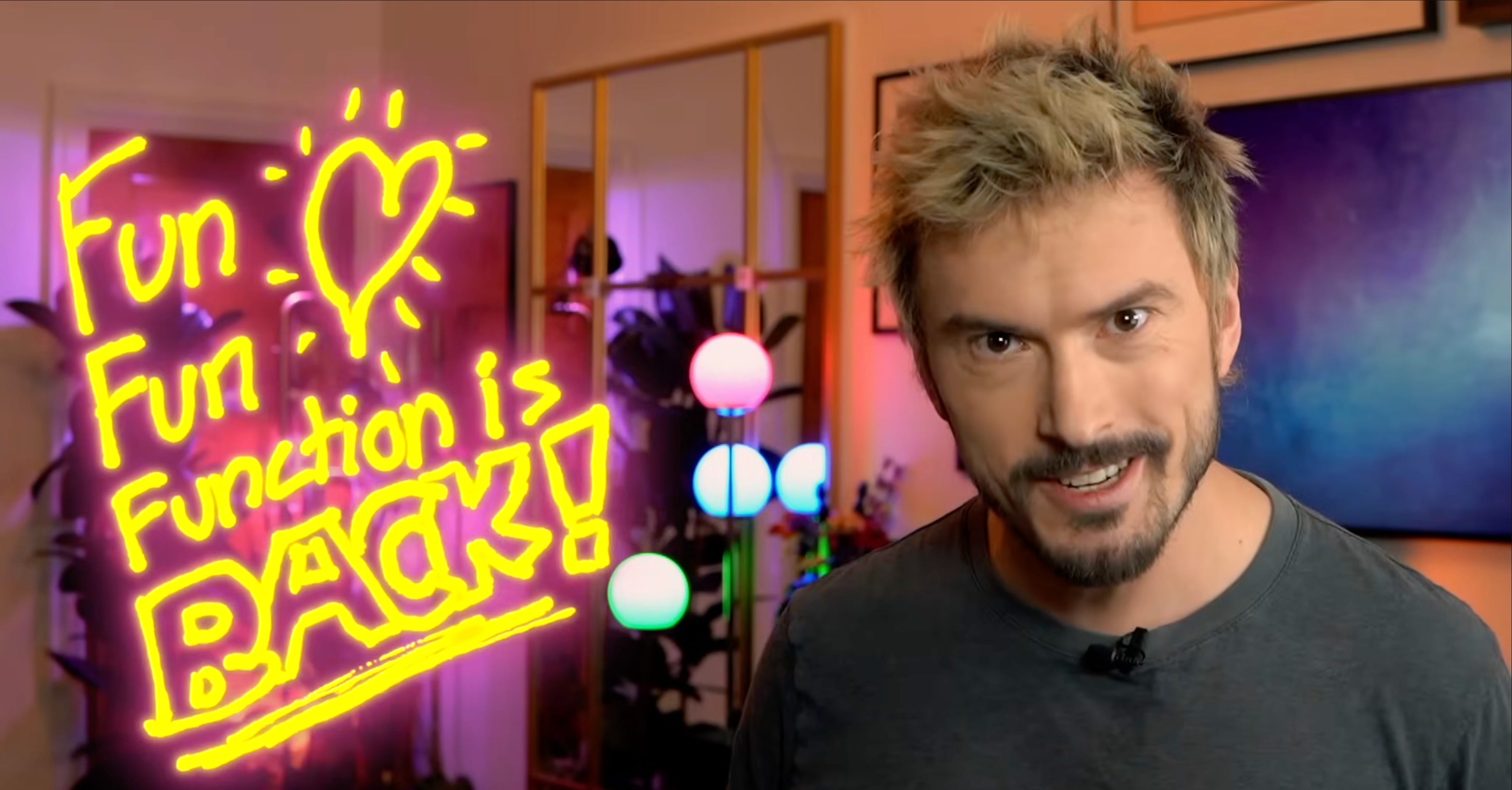
Watching the announcement video, I am demonstrating suitable levels of YouTuber energy, perfectly masking my actual state. In reality, I was burnt out, desperate, at the end of my rope, both in terms of confidence, financial security, and quite frankly, identity. I’ve never been laid off from a job in my life, and during 2023, I was fired twice, which disrupted me so much more than I could have imagined - at one moment, I expressed to my girlfriend that I didn’t know who I was.
Restarting Fun Fun Function required a hero, but at that point, I was the one that needed saving. However, that kind of vulnerability was unfamiliar terrain to me. Up until that point in my life, I had been a Prince of The Internet - a happy dolphin swimming the digital seas. Computers and the world of computing had always treated me well.
Me and the Internet grew up side by side.
I was born in 1983. I was the last generation to do BBSes, my first phone was an Ericsson T18 and the site that I’ve wasted most time on is Slashdot. Eventually, in my later teens I found my people and place at the Sitepoint.com Forums, as a moderator and article writer - it’s where I published my first piece of authored code: A DHTML tree menu written for Intellected, which was a home page I built to document my interest in mnemonic techniques. It has long perished, but I actually found some remnants of it on Wayback Machine, demonstrating a wonderful Windows XP-like aesthetic and what was my favourite hex color back then: #99CCFF.
The timing of all this meant that I learned computers before computing was the shit. Last year, a friend of my father came up to me at a family gathering and apologized to me for telling me when I was a kid (and I have zero recollection of this advice) - “Mattias, this computer interest of yours is a good hobby, but eventually you need to also learn something that you can do to earn money”.
Programmers in 2010:
Rare, expensive, magical cattle.
I kind of coasted through the job market for about 25 years or so - my unintentional timing could hardly have been more impeccable. My peak was working for Spotify during the glory days of tech - long before Cambridge Analytica. All was fine and dandy. Programmers were a kind of rare, expensive, magical cattle that needed to be exercised at ping-pong tables and take regular baths in ball pits.
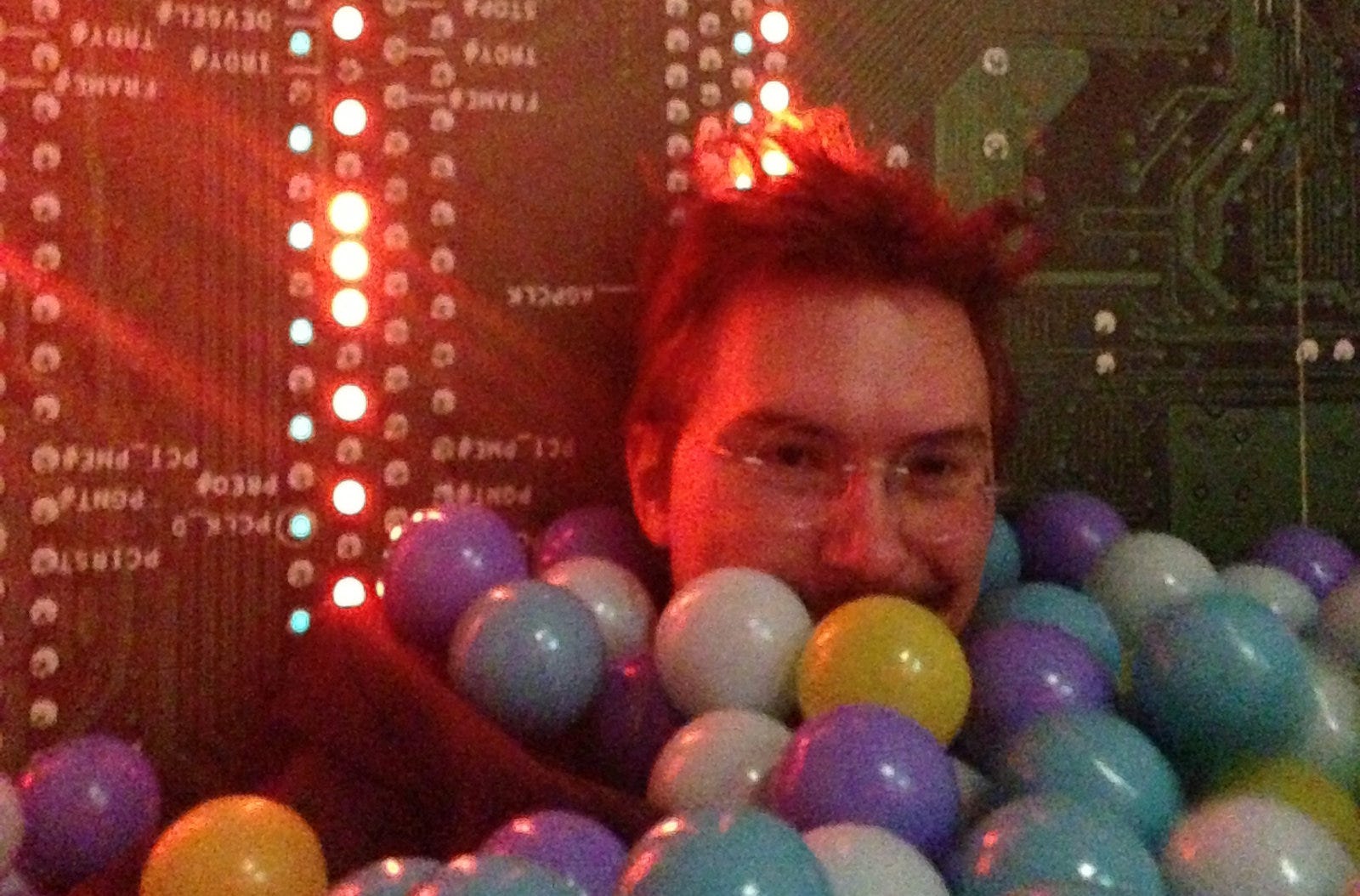
I was part of the Playlist team, so I maintained code that literally touched hundreds of millions of people’s everyday lives, which is something I had strived for since I learned programming, believing that meaningful work would make me content and fulfilled. But one day, wondering why I was depressed even though I had 500% objectively made it, I looked through my journal and realized that I had spent an entire year optimizing scroll performance of long playlists.
I don’t mean to belittle my work on scroll performance - that is genuinely important work, especially at that scale - I likely knew more about DOM redrawing than 99.99% of people on earth and I’m proud of that part.
In fact, I love and admire geeking out about insanely niche things - I found myself mesmerized and inspired from this story about Fil Riviere spending 4 years on digitizing the Bertin projection.
The problem with my work of playlist scroll performance, and what made my work different from Fil’s work on the Bertin Projection, is that his came from within him - it is part of what builds his unique oeuvre, not something he was commissioned to do.
Always start this weekend.

It is those inner embers that eventually compelled me to buy a Blue Yeti mic on a friday and shoot the first episode of Fun Fun Function that same weekend. Not even with a proper camera - I just used my normal laptop webcam. I had a TV production background from before, but I knew then that I would procrastinate the project into oblivion if I allowed myself to even google for one second what camera to get.
Just. Get. Started.
I said that I spent a year optimizing scroll performance - though if I’m honest, I spent a ludicrous amount of that time procrastinating from work answering questions on Quora.
Quora was the best place back then, incredibly pure, with chemists answering my questions about how to keep muffins fresh, and gut-and-heart-wrenching writing from inmates at San Quentin answering what the first day of a life sentence feels like. I found a niche answering JavaScript questions and managed to transfer some of the attention to Twitter, which became the seed for my first subscribers on YouTube.
Demons captured in commitment boxes.
Nowadays I have a clinical diagnosis of ADHD with medication, but back then I made do with various coping mechanisms. Being justifiably fearful of my tendency to procrastinate, I constructed a commitment box made of adamantium for myself. You may know it as the phrase “Good Monday Morning”, the line that opened every episode of Fun Fun Function — I know it as the prison I intentionally built for myself that allowed me to do what is still, in many ways, my life’s work.
I produced Fun Fun Function every week, largely without fail. For the first two years, during the weekends, and for three years after that as my full-time job. Some weeks it was mostly a delight, some weeks it was mostly a chore. But it was only the first few episodes, before I locked myself in with “Good Monday Morning” that felt creatively pure, if that makes sense. After that, there was always, to at least some degree, a struggle, a tug of war, between the intrinsic motivation and the duty of consistency. I never really got that intrinsic fire back, not completely.
Some of the more intense struggles showed up in the Losing Motivation video and Worst Hello World Ever, that were two examples of solutions to the problem “how can i make a video when i dont want to make a video”. I constantly hoped that I would find the tactic that would keep me engaged consistently, but my inner motivation refused to let me re-use a prior strategy. The demon of novelty would not be satiated for long.
A return to Fun.
Where am I going with this, you ask? I guess it is a restatement of what Fun Fun Function is, in a more authentic way. funfun.email will be at the center, I might produce videos from time to time, but that will be rare. AI and other tooling has augmented video production a lot, so producing great video is more efficient than ever, but it also means that it’s more competitive than ever.
Hypothetically, I could make something “good enough” but for some reason I am just not built for that. My creative neurology seems to only thrive in the point of crisis, in the crux of complexities, the tipping and turning points, the forefront. Whenever I try to aim “easy” production, and reap the rewards of my built skills, and “do a standard video with one hand tied behind my back” sort of thing, it just doesn’t WORK.
It’s like oxygen is drained from my blood, and I procrastinate until the last few hours and reflexively invent an over-ambitious production complication to raise the stakes and make something much more involved in less time - blasting past the deadline, the guilt of being late fueling a feverish fervor, generating the energy required to push me past the finish line with something convoluted enough that my inner demons deem adequately worthwhile.
I can find myself working for insane lengths of time on intrinsically motivated things, but if I introduce even a whiff of external motivation into the work, my neurology tends to drain the blood from my face. For years, I did talks happily across the world for free, but the first time I was actually paid for a talk, suddenly preparing it was like pulling teeth.
I really miss the days of creativity without duty or ambition mixing itself in, without the idea of something being a startup or that what you’re writing needing a certain number of views. I miss non-performative creative expression. Just doin’ something because I find it deeply interesting, following a subtle whimsy, respecting my own salience.
So I’m going to just be doing funfun.email for a while, and very intentionally NOT with a regular cadence, and writing when I want to about what I want to. And absolutely no ads or subscriptions for the foreseeable future, I want to see what it feels like to do this with absolutely no pressure.
When I say Return to Fun, I do not necessarily mean pleasurable or even light-hearted - but more about a stance toward how the world is changing at this time in history.
So this is not a return of Fun Fun Function, but it is a return to Fun.
A computing cavalcade.
It is very unclear where AI is going to be taking me (or any of us), career wise, in the coming years. In many ways, it’s liberating for me that AI breaks the economics of code, because in a way, the fact that coding was so valuable was what made me stop doing it for fun and instead doing it for others, paying me. There was a period in my youth where I would obsessively ideate business plans that I ought to do, and now it is incredibly hard for me to think of a single idea with even a reasonable moat.
Looking at my feeds, it seems clear that coding agents are doing incredible things in terms of art and software development, and human creativity in general - the amounts of ingenuity I see on a daily basis is absolutely staggering. Tooling is created at a dizzying pace, some useful, some delightful, by people that could not fathom coding before.
Which is quite disconcerting on so many levels, but also - all risks and disruption and collateral damage put aside - it’s quite something to see upfront - what a show.
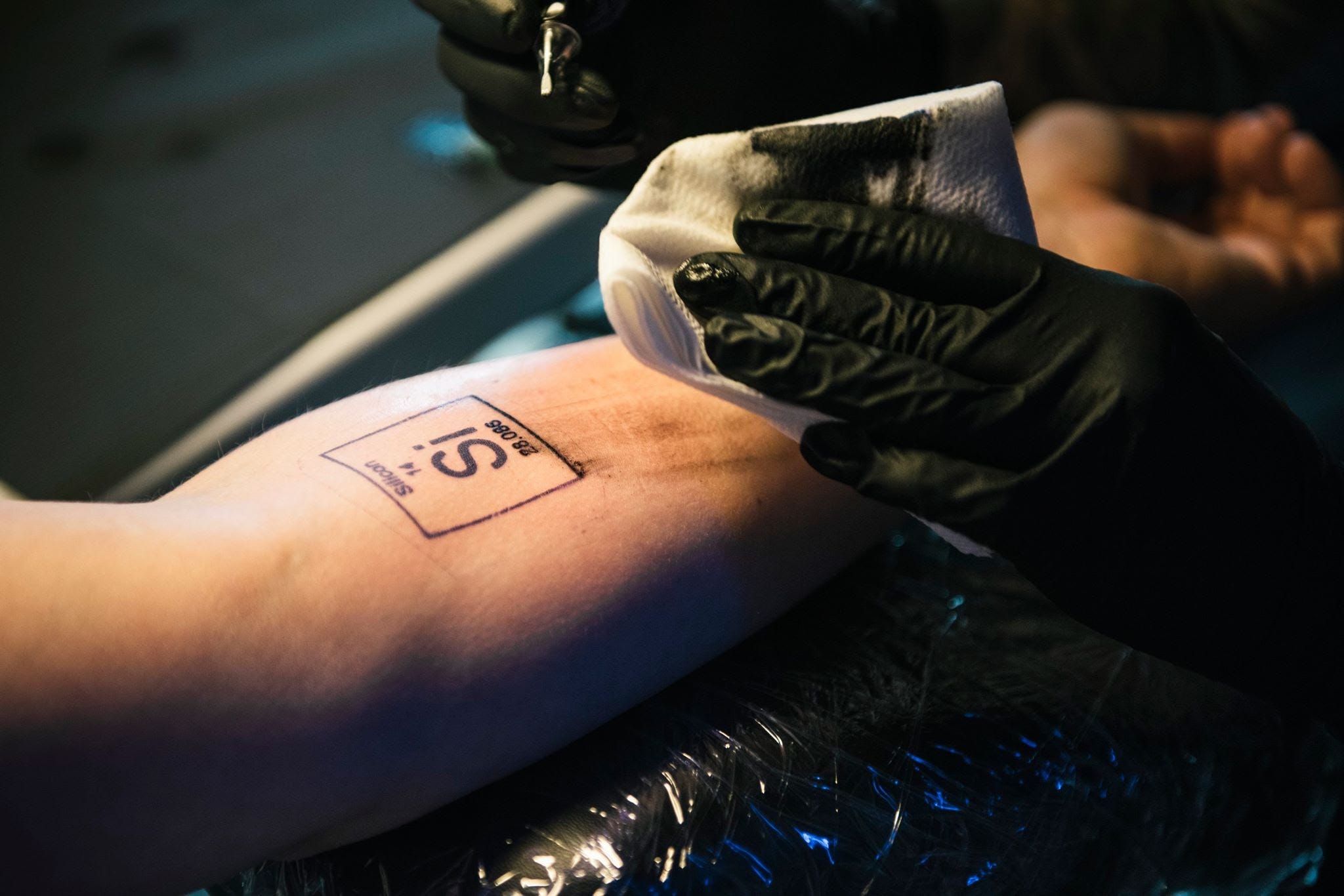
Especially for someone that grew up with CPUs. I have silicon’s cell from the periodic table tattooed on my left arm — Si, element 14, the fourteenth thing the universe learned to be, and somehow the one that learned to think back. A reminder of how much these things have affected me, and how much of what I have and what I am, I have computing to be grateful for.
I find myself grateful that I am just old enough to have my first computer be an Amiga 1200, a very powerful gaming-oriented computer with mind-blowing graphics running on a Motorola 68EC020 @ 14 MHz and 2MB memory.
Leaning fully into this, what we live with today in terms of capacity is so awe-inspiring that my eyes well up with tears if I allow myself to fully feel it:
A single H100 does roughly 1,000 trillion BF16 floating-point operations per second. For the sake of argument, I’ll assume that you need 8 of those turkeys to run an inference shard of Opus 4.7, requiring around 8 petaFLOPS. Compared to my Amiga, that’s a factor of about a billion times more arithmetic per second.
If my Amiga had been computing one Opus token since the Big Bang, it would still be nowhere close to finishing the matrix multiplies that the actual hardware does between pressing Enter and the first word appearing.
I find myself deeply privileged to understand computing well enough to appreciate what is happening - but also understanding the upcoming challenges currently hidden because providers are subsidizing what compute really costs. I’m currently reading eagerly about Quantization and prompt caching because god knows we need to make these things run much, much more efficiently.
What if these are the good old days?
I would not for the life of me trade this for flying cars or jetpacks - there is no other age I would like to be in. Don’t get me wrong - I am not a person that is positive about the future. Nor am I negative. I subscribe to being optimist as David Deutsch defines it:
“Optimism is, in the first instance, a way of explaining failure, not prophesying success. It says that there is no fundamental barrier, no law of nature or supernatural decree, preventing progress. [...] There is only one way of thinking that is capable of making progress, or of surviving in the long run, and that is the way of seeking good explanations through creativity and criticism.”
— David Deutsch, The Beginning of Infinity (2011)
Last year, I wrote a chronicle about William Playfair, a statistician that invented the line plot, that lived in the era of Descartes, Napoleon, David Hume, Adam Smith, the French Revolution, the invention of the steam engine, protests (and hangings) against agricultural automation. Playfair lived during a titanic shift in history and knowledge, arguably in the greatest melting pot of engineering and science since Ancient Athens.
I wrote that chronicle from a hotel in Granada, being quite drained and feeling quite small in life, and I remember at the time feeling a certain pang of jealousy against Playfair for living in such a defining era of humanity. I realize now, with my feet a bit more on the ground, with more security around me, and some rest and silence, that someone might be writing about this point in time with that same reverence.
On some days, it is hard for me not to be overwhelmed with the meta-crisis that the world is going through, but on good days, when my mind is clear and sharp, and my heart beats strongly, I remind myself of the etymological origins of the word crisis:
krisis | κρίσις | /ˈkriː.sis/ — noun, Ancient Greek.
The turning point; the moment of decision.
The instant when the fever breaks one way or the other.
From krīnein, to separate, to judge, to decide.

Things are currently too much in flux for me to see clearly what my role ought to be in all this, and I suspect I share that experience with you, and most people that have spent their entire career in computing.
For now, we just have to stay open, experiment, take interest, play - and wait.
...which is, I suppose, another way of saying:
Stay curious.
Thanks to you, I dove deep into Frontend development, JS comprehension, and web development in general. Me and some friends loved watching your videos every week, and I also remember texting each other when we saw your 2024's comeback video, just as we just texted about this new email. I rarely read anything more impactful than your writings, and I hope you are doing well (or at least, better)! I also hope your will not write another email too soon, in order to stay healthy and not trying to "catch up" with us, or whatever.
Thanks!
Good to have you back!