


Good Monday morning - how are you feeling today? Or rather, what are you sensing? What is going on in that body of yours?
I'm writing this from a rather grey February in Stockholm, caught in that transitionary period where the snow has abated but spring hasn't quite arrived. We get the occasional bright, sunny day, but mostly it's grey and nondescript.
While Sweden is a wonderful country, the weather isn't one of its greatest features. Nevertheless, let's dive into something that's been on my mind: measuring sleep data, and tracking subjective experience in the body.
The Curious Case of Sleep Tracking
Sleep data is fascinating because it sits at an interesting intersection. While precise measurements of deep sleep and REM cycles traditionally require electrode-based polysomnography, we can now get surprisingly accurate approximations through wearable devices. The Quantified Scientist [YouTube] has tested various wearables against professional sleep tracking equipment. The latest Apple Watch versions, for instance, come remarkably close to professional measurements.
These devices use a clever combination of proxy sensors - accelerometers, heart rate monitors, and temperature sensors - matched against professional-grade measurements to create meaningful approximations of our sleep patterns.
Rise: The Actionability Problem and The Social Element of Sleep Data
I've been tracking my own sleep for quite a while, including a stint with an Oura Ring [Company Site]. These devices provide all sorts of metrics about "readiness" and sleep quality. But I've struggled to find truly actionable insights from all this data collection.
The closest I've come to finding genuinely useful sleep tracking is an app called Rise. [Company Site] Unlike other apps that focus on complex sleep stage analysis, Rise takes a refreshingly simple approach: it just tracks total sleep time and sleep debt.
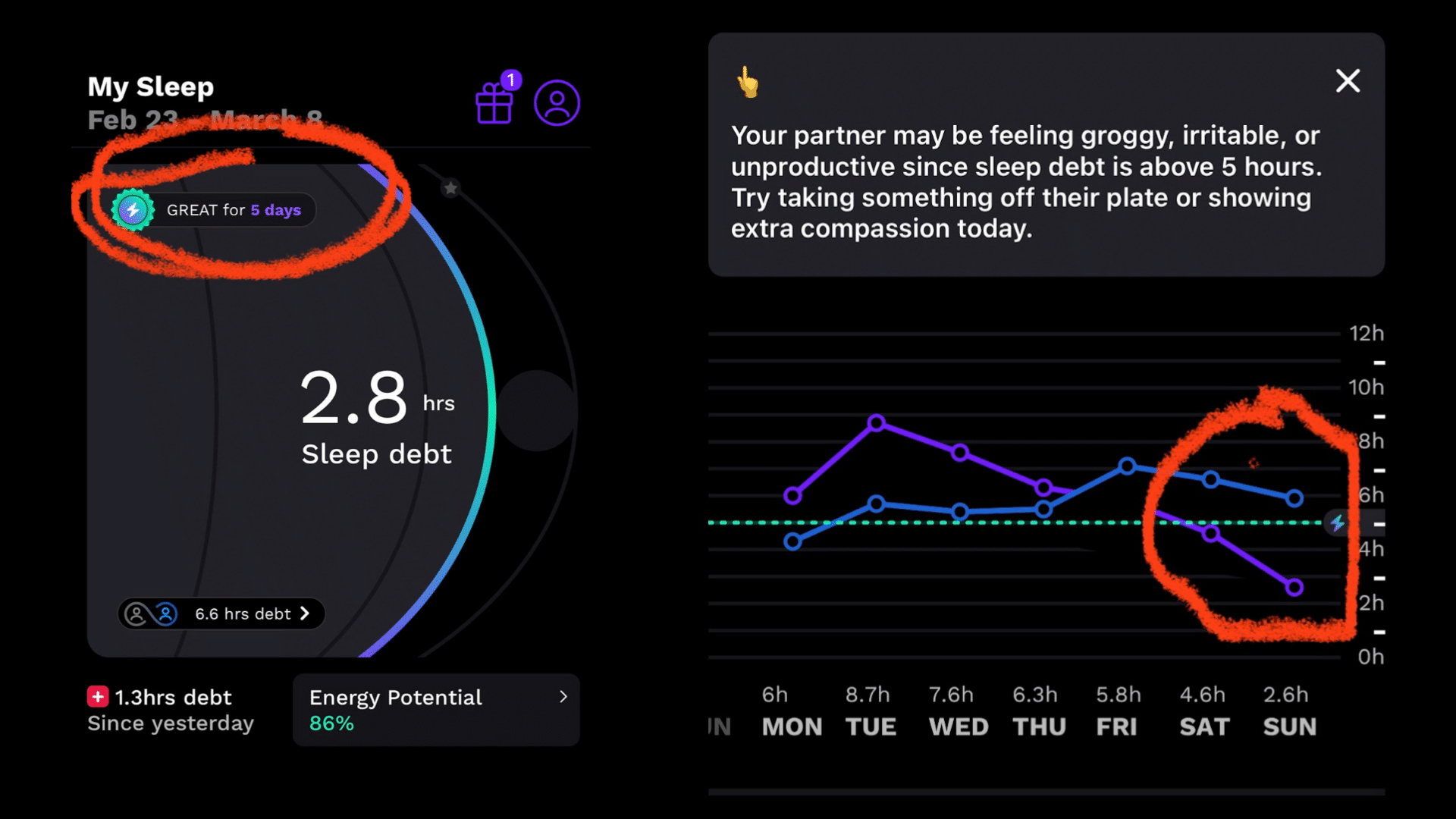
Here's where Rise gets interesting - it allows you to pair with your partner's data. You see your sleep debt graphs side by side, which creates a fascinating dynamic. You can tell when your partner hasn't been sleeping well, prompting you to perhaps be a bit gentler with them, avoid late-night discussions, or suggest an earlier dinner.
It's a beautiful example of using data in a simple yet meaningful way - creating accountability and providing a shared vocabulary for something that's typically hard to discuss precisely.
The Body's Built-in Sensors

There's an interesting counterargument to all this self-quantification: we already have incredibly sophisticated biological sensors - our own bodies. As one of the Hard Fork [Podcast Homepage] hosts pointed out (while playfully mocking his more quantified-self oriented co-host), you can simply check in with your body to see if you're tired and then go to bed early.
I have previously talked about how I stopped using my HidrateSpark [Company Site] smart water bottle after I reflected on how I was further exacerbating my dissociation from my body by buying a product that measures my body and blinks with an LED what I should be able to sense internally with no issues.
It's somewhat ironic that we have this incredible neurological system with billions of interconnected cells, yet we often trust a simple accelerometer strapped to our wrist more than our own bodily signals. We've become so disconnected that we rely on tech companies to do our observation for us.
Finding Middle Ground: Quantified Intuition
However, I think there's a middle ground between pure technological measurement and pure bodily awareness. The critics of quantified self often swing too far in the opposite direction, rejecting measurement and aggregation entirely.

What if we combined both approaches? We could start by actually observing ourselves in the morning - noting our energy levels, mood, and general well-being - and then recording and tracking that data. After all, sleep is complex with many contributing factors, and the ultimate metric we care about is how well we function and feel afterward.
In fact, no matter if you do tracking of the the proxy metrics of accelerometer, temperature and heart rate, and leverage derived metrics like deep sleep and REM sleep, or elusive “sleep quality” aggregate metrics that many sleep apps have, in the end we need to actually have a success metrics that we are gunning for, and reasonably it needs to be something self-reported that correlates with us thriving.
Yes, self-reported data has its problems, but when it comes down to basic quality of experience, if we are good or not, it must be self-reported.
The Path of Least Resistance

The reason we often default to automated tracking is simple: it's less effort. Anyone who's worked with data engineering and analytics in a corporate setting knows that the most commonly collected data is often what's gathered almost accidentally - website clicks, user interactions, etc. Intentional tracking tied to specific success metrics is rare because it requires significant effort and organizational consensus.
In personal tracking, though, we have complete control and can create simple systems to track this. We can decide to track our subjective sleep quality every morning, perhaps 90 minutes after waking (when the adenosine has cleared our system) with a simple sticker-marker system on paper and enter it later into a CSV, which we then pull into ObservableHQ [Company Site] or Hex [Company Site]. This direct measurement of our success metric - how we actually feel - could be more valuable than proxy measurements from our devices.
Maybe the simple act of tracking makes us more mindful of our sleep quality (“what gets measured gets managed, and all that, plus I suspect actually measuring as opposed to just reading graphs of measurements is a powerful distinction in this context). Plus we can still correlate this subjective data with the automated measurements we're already collecting, to see if deep sleep actually does make our days better.
A Glassdoor for Sleep Quality?

One of my wonkier data ideas was generated by a psychologist at Mindler [Company Site] - a European BetterHelp with only licensed psychologists where I worked as Head of Data for a couple of years. The psychologist mentioned something fascinating, but not exactly surprising: virtually every mental health condition and external stressor manifests in disrupted sleep patterns. Given that we spend a huge chunk of our lives at work, our workplace environment inevitably impacts our mental state – and by extension, our sleep.
What if we could leverage this connection by pooling it together? Imagine a community-driven platform where people anonymously contribute their sleep metrics and employer information into a shared pool. We could create something akin to a "Glassdoor for Sleep" – a way to see which employers have the most well-rested employees. Not just another corporate wellness metric, but a genuine insight into how different workplace cultures affect their employees' fundamental well-being.
The beauty of sleep data is that it's both deeply personal and remarkably universal. Unlike traditional employee satisfaction surveys, sleep patterns can't be gamed or manipulated – they're a raw, honest signal of how our work lives affect our biological rhythms. Of course, we'd need robust anonymization and aggregation to protect privacy, but the potential insights could be transformative for understanding workplace well-being (or at least, it would give you an idea of what workspaces lets you sleep well at night)
Maybe an FFF community project, who knows... It is raining today, after all...
Making Cholera Beautiful
On a final note...
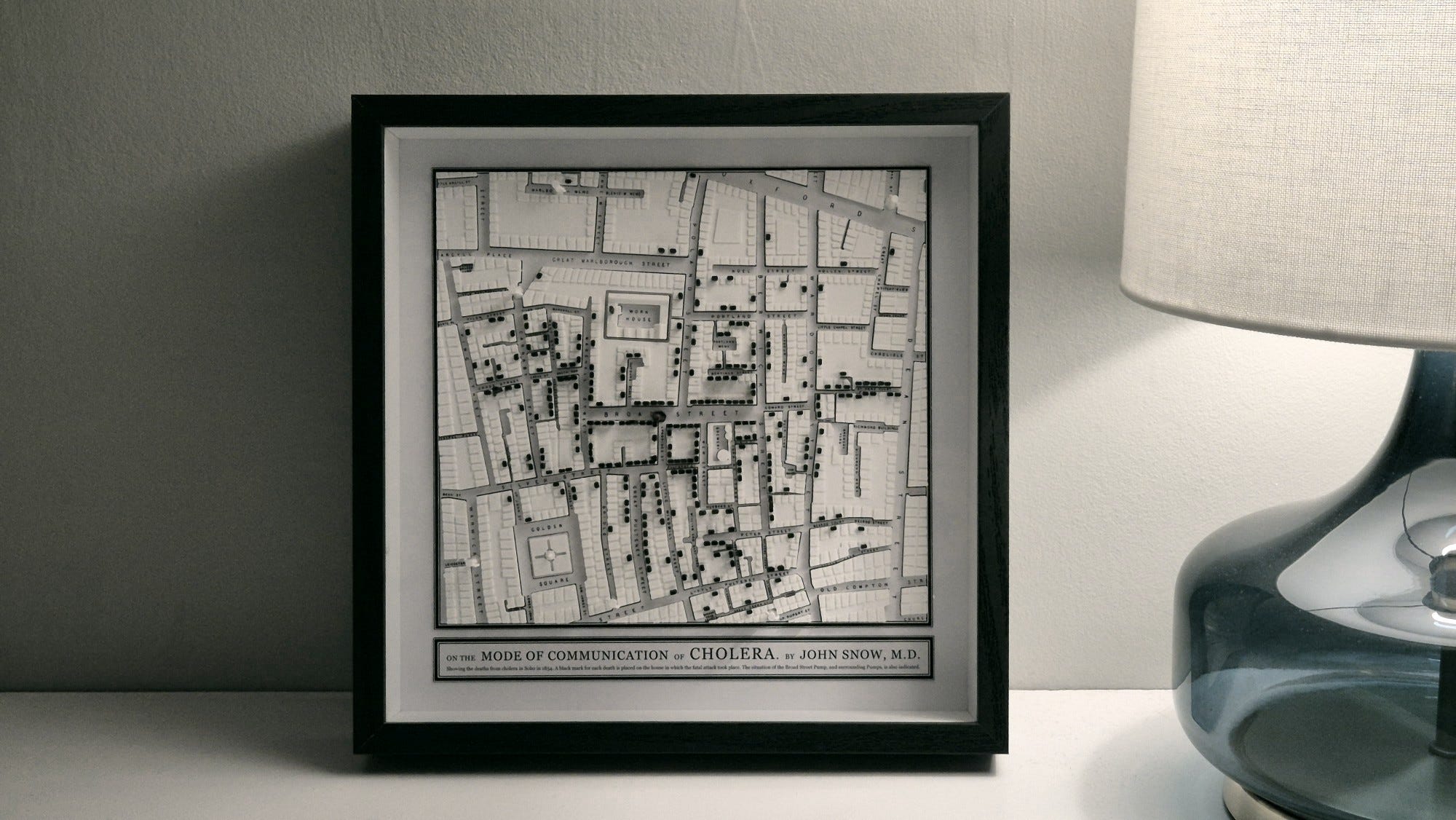
I was recently made aware of 30 Day Map Challenge [Project Site]- a yearly community event that pushes the boundaries of geospatial visualization, where participants create and share one map per day based on daily themes throughout November.
There is a really cool #30DayMapChallenge hashtag going on on BlueSky, where among many other amazing works, Alex Selby-Boothroyd posted this piece - quite an achievement to make cholera beautiful:

It seems, by the way, that Bluesky is the platform that is winning over the scientific community and I am also loving the starter packs feature [bluesky.com]
So it's highly likely that Bluesky is the microblog I will be using after X goes... Threads was working out for a while and then it went all algo on me and Bluesky is the only one that has that nice raw internet feeling that I like.
My Bluesky handle is @mpj.fff.dev, if you'd like to join me - not posting much yet, but a little.
As always, stay curious 🧐🐒
Mattias Petter Johansson