


Good Monday Morning to you and all summer kits (if it's summer where you are)
Writing this from the country again, Swedish summer lasts for about 17 minutes and we try to desperately enjoy it while it is here.
The place we are staying at is a favourite of ours, it's a weirdly cheap hotel located next to a golf court. I am not a golfer whatsoever, and originally we booked the place because it was cheap and away from the city, but but this week I discovered an amazing life hack: nobody golfs early in the early morning.
This is an important insight, because golf courses have an amazing air about them when they are completely empty in the early morning.😱🥳
Walking barefoot over the green as the only person of a golf course and getting surprise-soaked by the automated sprinklers because your attention was trained on a beautiful sunrise is an experience I wish upon you all. 👣

There is a serenity to the vast, half-controlled, half-nature visage of an inactive golf course, and I plopped myself out at a tee box on higher ground, and did one of my favorite breathworks (and I'm a snob with them): Energy over Time by Finnian Kelly (Available on Othership or MP3 download on Hay House). If you need to move your mind away from overwhelm towards powerful focus, this one helps a lot.
Announcement: I am hosting three virtual co-working sessions on Flow Club this week.
On August ...
*** Mon 12th
***** Wed 14th
*** Fri 16th
... I will be hosting live co-working sessions on Flow Club!
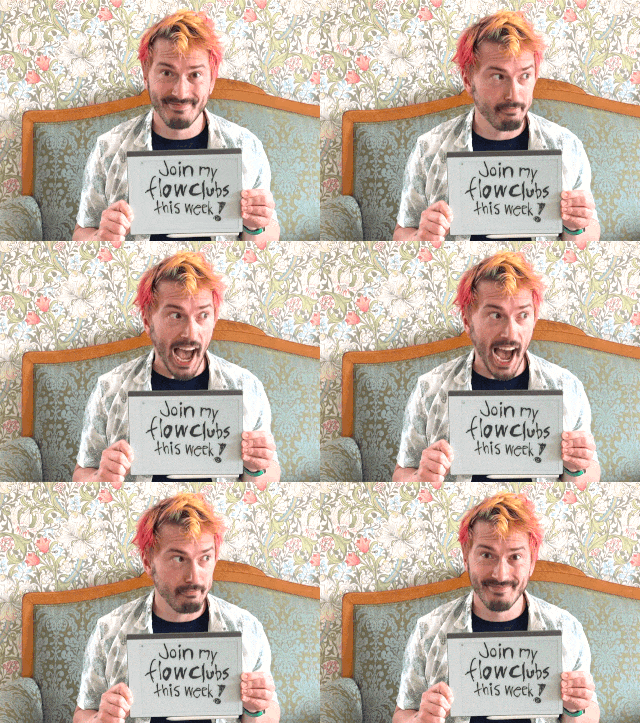
If you are a Flow Club user, please do join in, and get some shit done with me!
⏰ 👉 You can view the session schedule
in your timezone at fff.dev/flowclub
Note that each session only has 8 seats, and are NOT exclusive to FFF members so book as soon as possible if you want to join. (I might start doing some FFF-only sessions in subsequent weeks if this turns out to be popular, but for now it's open to all of Flow Club).
If you are not yet a user of Flow Club and want to try it out for the first time, make sure that you use the above link, as that extends your free trial to 14 days instead of the standard 7 days. You also get an additional 30% off if you also use the code MPJ30 at checkout.
I have been using Flow Club a tremendous amount in the last year, but this shamefully is my first time actually HOSTING sessions, and I'm a bit nervous. The confidence from hosting tons of weekly live streams on FFF evidently doesn't transfer to a new format 😅
If you don't know what Flow Club is, there is more info on them in the sponsor segment further down in todays Chronicle.
Advice column: The feeling of needing to earn more, even though we lack nothing

Reader Soufiane wrote in this week, and it was such an interesting question I wanted to write a response to share broadly.
Thanks for the newsletter, I discovered your youtube channel recently and I enjoy your videos very much!
I am a freelance web developer. I have some work, mostly custom e-commerce websites with nextjs sanity and shopify, but I feel like I need to work faster and more to do more projects and earn more, even if my needs are completely taken care of, and don’t lack of anything material thing currently.
It’s this feeling of falling behind, or not earning as much this month/year than the month/year before.
Is it lack of motivation, fomo or something else that is bugging me?
I personally like to label the thoughts I am currently stuck with. It helps me categorise and process things faster.
Anyway, thanks again, I thoroughly enjoy your content.
Soufiane
First, Sofiane - thank you for sharing your emotional discord.
I heard recently the theory (I don't remember the philosophy cited unfortunately) that humans experience much too many emotions to handle, and that we rely on co-processing in pairs and groups in order to handle it. I.e. they theorized that it is literally impossible to process everything that happens emotionally, so either we have to suppress or share in order to keep up.
I am not sure how true that is, or even if that would be provable, but it is certainly a beautiful and potentially useful model to think about the world.
The graceful power of perspective
But sometimes we are alone, and then labeling is an effective way of creating perspective on emotions.
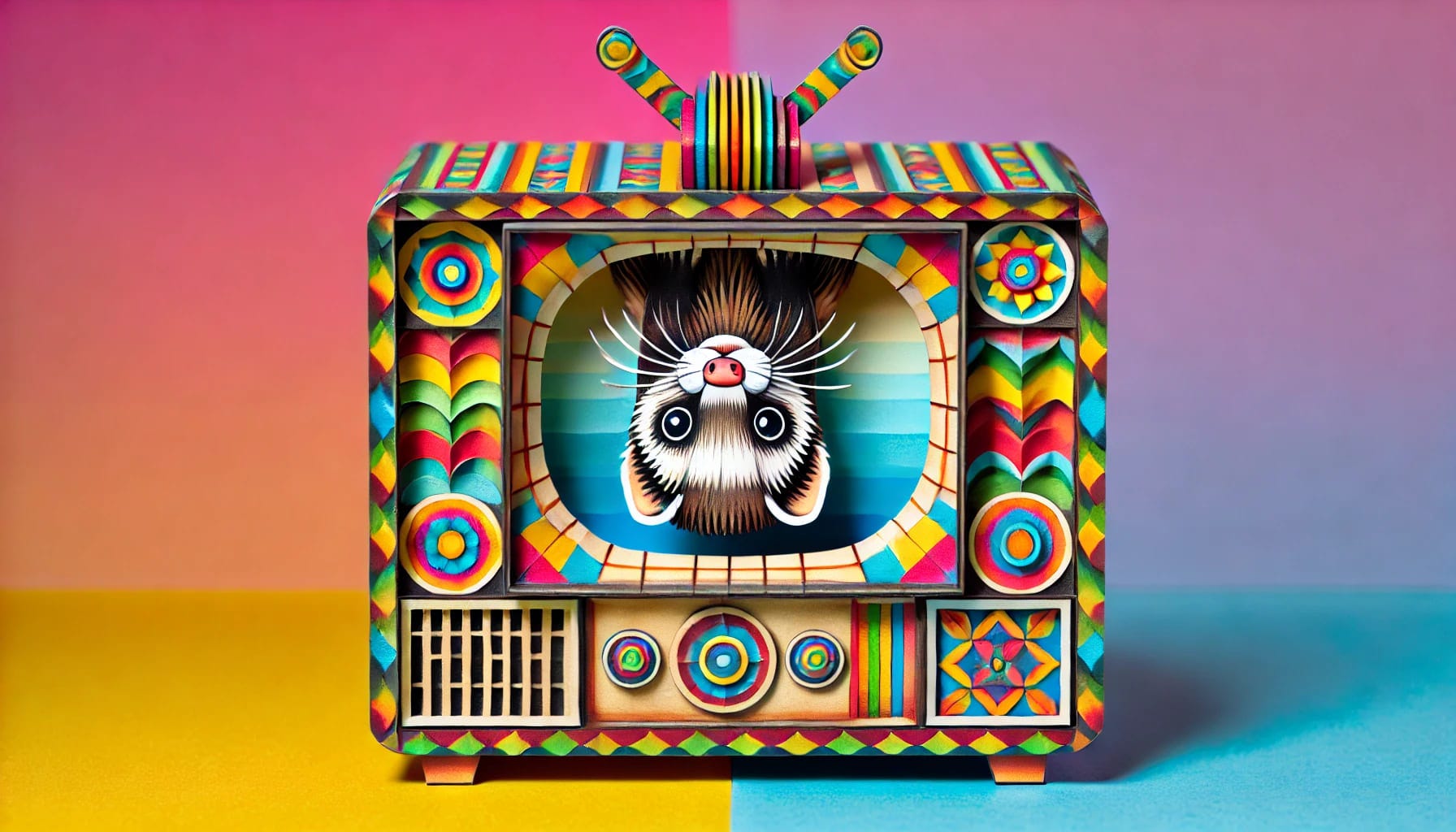
Other variants that I've been taught by psychologists (if an image or past situation is bothering you) is to imagine the situation to be inside a TV, and change the color of the TV screen, turn it upside down in your mind etc. The default experience of a memory or feeling is that it runs in your primary "workspace" and becomes reality.
Practicing our skills at finding ways to be grounded in reality is extremely valuable, because our minds have almost complete capabilities to make imagination real (as anyone that has had vivid dreams can attest to). Emotions are real, not reality, but that difference is only academical unless you spend time training yourself on discerning the difference, with tools such as labeling.
Labeling is a tip-of-iceberg technique and there is so many ways you can develop that. I have personally used the apps Waking Up and Othership a lot, they have massive amounts of material that focuses on the matter that were very important for my development in wielding sensations and emotions better. Not to digress further here, I will at the end of this chronicle mention an interesting article about Internal Family System (IFS) at the end of this chronicle which is a novel but (in my opinion) promising leaf of psychology.
But you are not alone. I mean, really, really not alone. At all.
However, in this case, I'd like to do the opposite of grounding and self-inspection, and expand the labeling to a more broad interpretation of this emotional response, because I suspect this one has an interesting and subtle universal nature, that we might even be able to find some data to support for if we look together.
If you (or anyone reading this) know of interesting datasets that explore regarding what I am about to muse on below, please send them my way, it can potentially make an interesting video this year (I have some ideas for a video series on interesting casualties).
Lets move past labeling this as "Soufiane's emotion" and instead label it as "The Emotion" as I suspect this is not really YOUR feeling, it is something you are feeling because WE are feeling it, as a society, or at the very least the part of society where the Venn diagram of you and I most overlap, the tech community.
I remember one period in my career where I coordinated a lot of teams, and during that period it became obvious that when a group becomes big enough, even just like 10 people or something, they start developing a kind of shared neurology that seems to be able to learn and behave independent of the individual members.
At the time, this insight felt woo-woo for me and in order to not give off too much neo-hippie vibes I kept the thought mostly to myself, but at one point I shared it with a psychologist in the organization and he said "oh yeah, that is not only a know thing, there is an entire field of study dedicated to it, called OBM - Organization Behavior Management".
From Wikipedia:
Organizational behavior management (OBM) is a subdiscipline of applied behavior analysis (ABA), which is the application of behavior analytic principles and contingency management techniques to change behavior in organizational settings. Through these principles and assessment of behavior, OBM seeks to analyze and employ antecedent, influencing actions of an individual before the action occurs, and consequence, what happens as a result of someone's actions, interventions which influence behaviors linked to the mission and key objectives of the organization and its workers. Such interventions have proven effective through research in improving common organizational areas including employee productivity, delivery of feedback, safety, and overall morale of said organization.
So the answer to my question "Can organizations be traumatized?" turned out to be "LOL we already have university programs that train psychologists for that"
Now, back to Soufiane's excellent question - I would like to zoom in on this part:
"I feel like I need to work faster and more to do more projects and earn more, even if my needs are completely taken care of, and don’t lack of anything material thing currently."
Are more people feeling like this than usual, and if so why?
First, this an incredibly eloquent way to describe an emotional state, well done.
Secondly, I think this is an experience that many recognize.
Third, there is an impulse to wave this off (or console) with
"oh that is the way things are and everyone feels like that sometimes"
... and leave it at that, but what if we instead stop and explore it more, maybe with the question:
"How many of us experience this, how does that vary over time, and what might be causal factors?
The following is going to be me musing unscientifically at this point, but if you, dear reader, have any interesting relevant data sources that proves, disproves or explores this link of thinking, send them to mpj@funfun.email, and I might explore this more with some aggregates and visualizations later.
oh yea MPJ is quoting aristotle again LFG

This emotional experience described is related to earning, and this quote comes to mind:
“The best and most suitable thing that a good man should amass is a broadly tradeable good, which should naturally facilitate exchange and be of value to everyone who participates in the market.”
-- from "Politics" by Aristotle
Aristotle published "Politics" in 350 BCE, so this is pretty much one of the earliest known formal discussions on the nature and purpose of money.
Money, Monetary Debasement, the Mysterious Business Cycle and Emotions
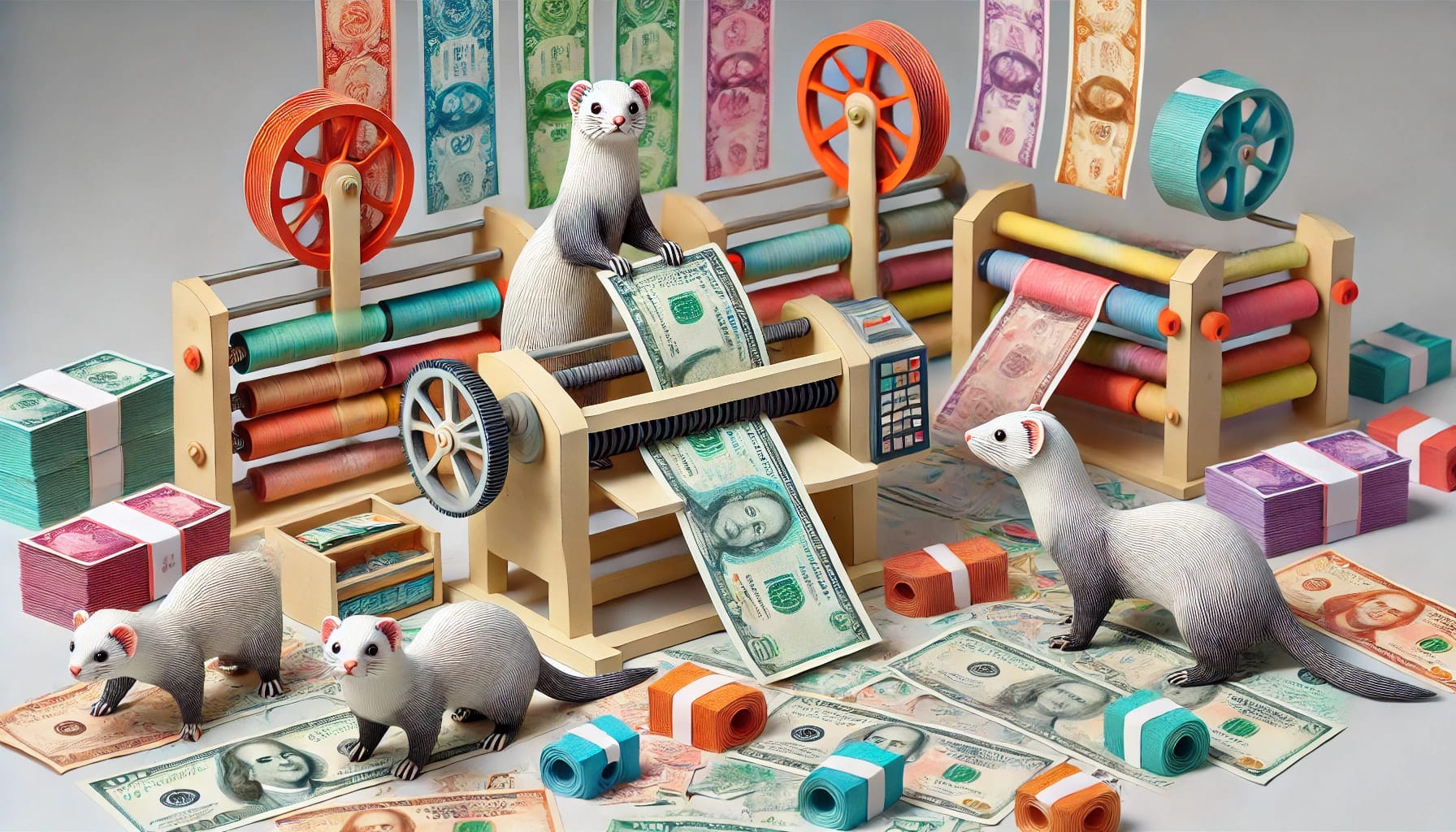
I would really love to do a data exploration into the relationship into monetary debasement and emotions in the population. I am very curious if monetary debasement of various forms broadly causes experiences like the one Soufiane describes. That elusive sense of "I need to earn more" seems to me a intuitive natural response to inflationary pressure.
I am particularly interested in more recent innovations in the categorys of "yes maybe it technically creates money but it is totally not money printing" mechanics like Quantitative Easing. QE is a rather new invention, and it isn't for long that we have historical data that can be used how they affect the well-being of the population.
I find QE and other mechanics to be particularly interesting because they are designed to not be money printing in the traditional sense (or kings reducing precious metals in coins before that) and doesn't cause immediate inflationary effects that can be easily sensed by the population, but they do generate a quite tremendous market effect so it would be interesting to see if the population as a whole "senses" it, even if you are not a market investor - it arguably affects tech a lot, because our industry is disproportionately dependent on venture capital.
But perhaps QE might this still be "felt" because of the indirect market effects it gives? If so, could this be measured?
We can intuit and feel 'money' and 'markets', but hardly 'Quantitative Easing'
By "intuition" I mean in the sense of System 1 (as defined in Thinking Fast and Slow) neurology is not sophisticated enough to fully grasp complex concepts like monetary debasement, or perhaps actually it can grasp simpler forms, but Quantitative Easing is damn hard wrap your head around.
However, system 1 is clever enough to understand that the money you are holding is becoming less valuable (just looking at prices and people around you saying "things are becoming more expensive" and it understands the concept of money (in the sense that it is the most saleable good in society)
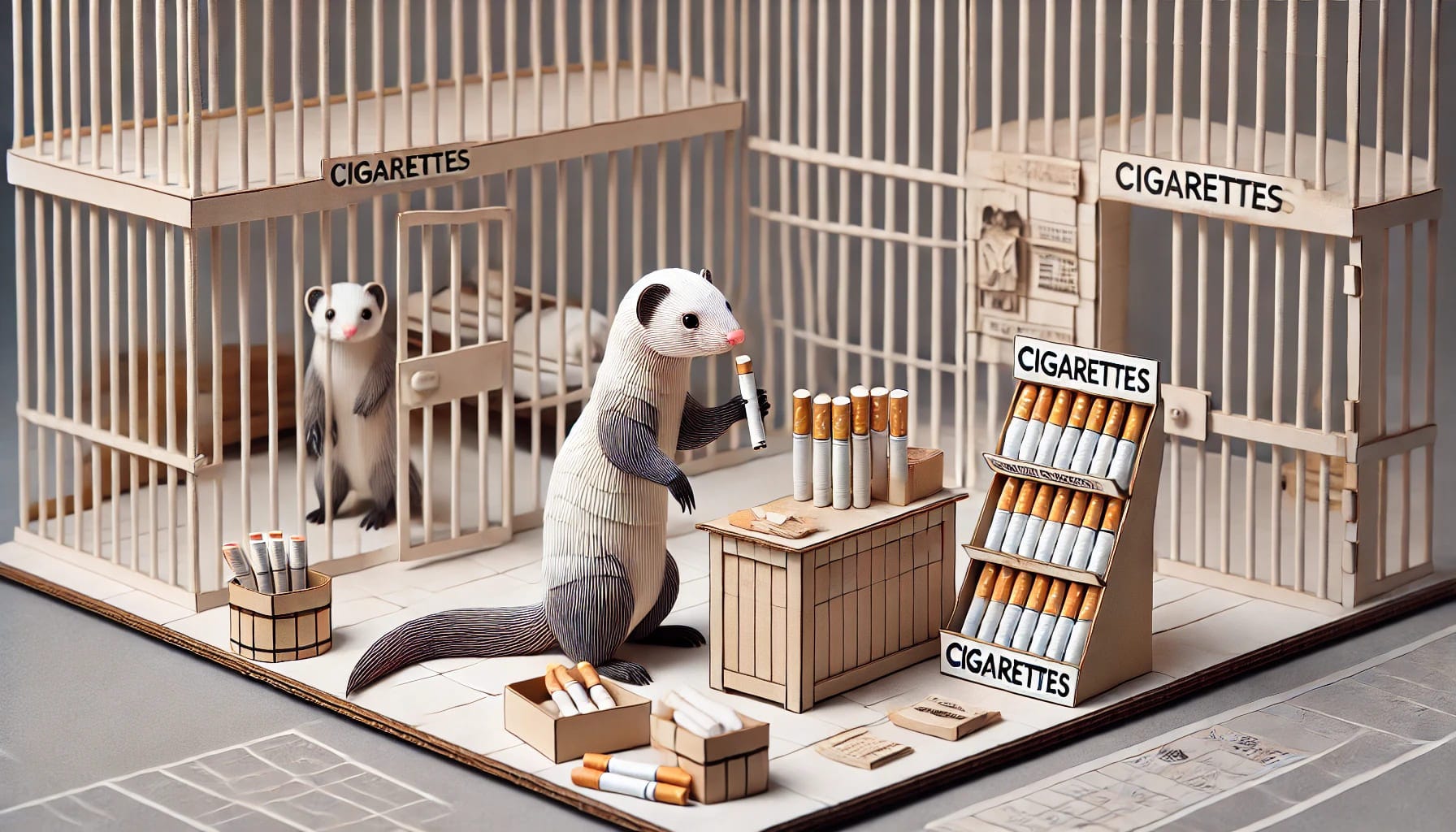
It is easy for anyone to envision that a non-smoker in jail, or in a collapsed country war zone, will immediately feel a sense of safety and calm if they come across a couple of packs of cigarettes even, because their intuition understands very easily that this is a tradeable good with extremely high liquidity and therefore gives safety.
So if we roll with the idea that our neurology has dealt with money for enough time to have it in our spinal column to some degree, what does all this shenanigans with QE and other mechanics do to us, emotionally and neurologically? We talk about it as a market correction mechanic, but money is quite deep human thing and we should perhaps consider emotional effect in this regard.
I feel like inflation is one of these things that is even awkward to measure in things like CPI because inflation is very individually FELT. I could (admittedly very arguably) be considered PRIMARILY an emotional effect.
While CPI and the like are useful, I think that we should also have some kind of measure that tracks the stress level of individuals that captures. I don't know what kind of proxy one could use here to track the vague sense of unease in a population that makes them feel that "they should have more even though they have the stuff they need for now"
The Business Cycle and its effect on mental health
As I was looking into this, I found some tangential exploration:
Impact of Business Cycles on US Suicide Rates, 1928–2007
Suicide rates are a crude proxy of well-being but I like it because it's hard numbers, and it seems indeed that suicide rates drop and rise in people aged 25-64 during recessions and expansions. 15-24 and 75+ aren't affected in this way:
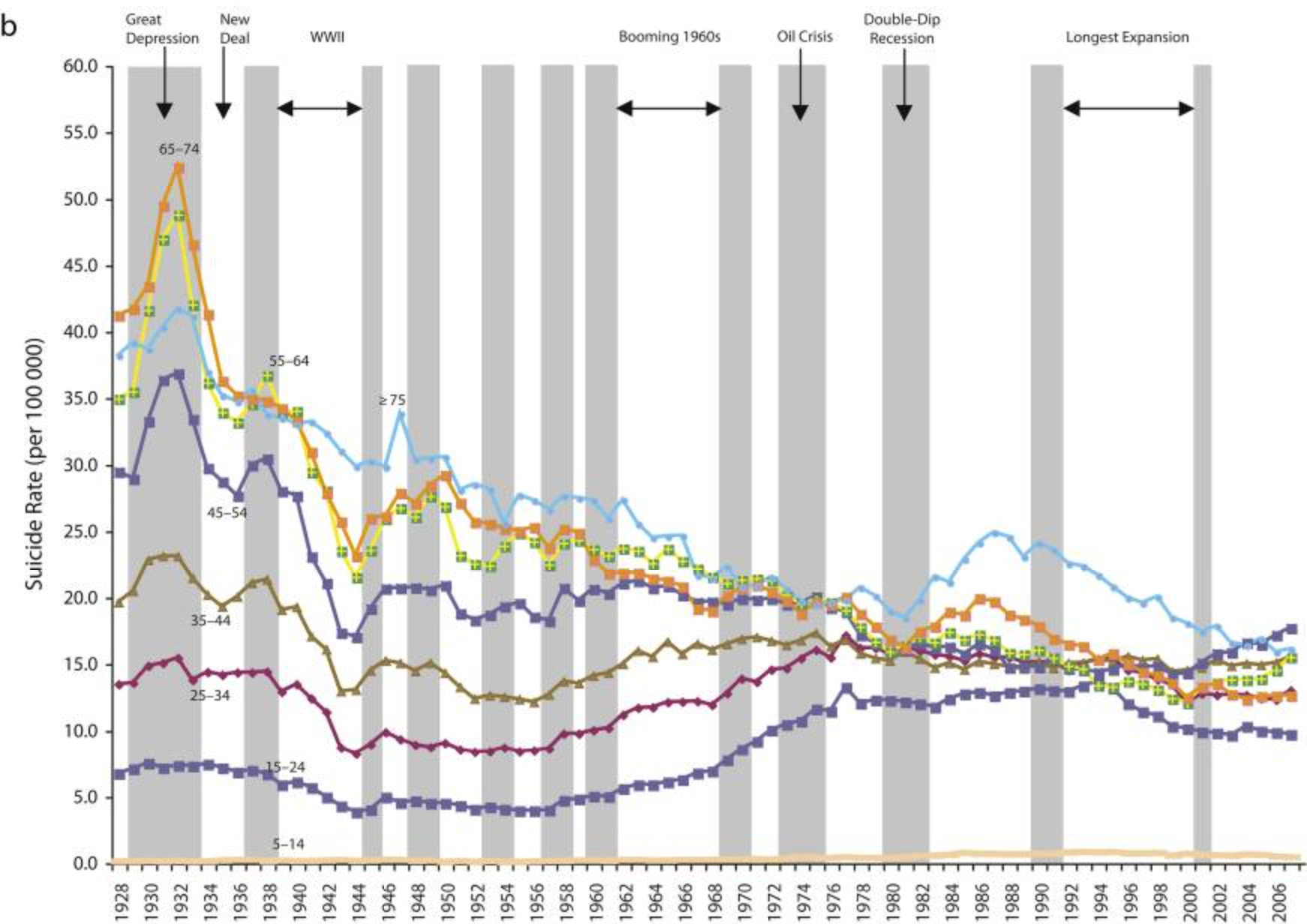
This is of course explained by less subtle factors than the one I am alluding to, if you lose your job you become isolated and depressed and feel unsafe and can experience as sense of hopelessness and failure, but I wonder if we can also feel more subtle shifts emotionally?
The mystery of the Business Cycle how it relates to emotions
I find the mystery of the Business Cycle in economics extremely fascinating. We know the business cycle is a thing, it is like a season, and somewhat predictable in that it goes up and down in a pattern, but unlike the seasons of nature that are caused by the sun etc, we can't exactly predict the market cycle, nor do we know what exactly causes it to be cyclical. There are many ideas, but no consensus - we just know that the Business Cycle is a real thing, and has been for hundreds of years.
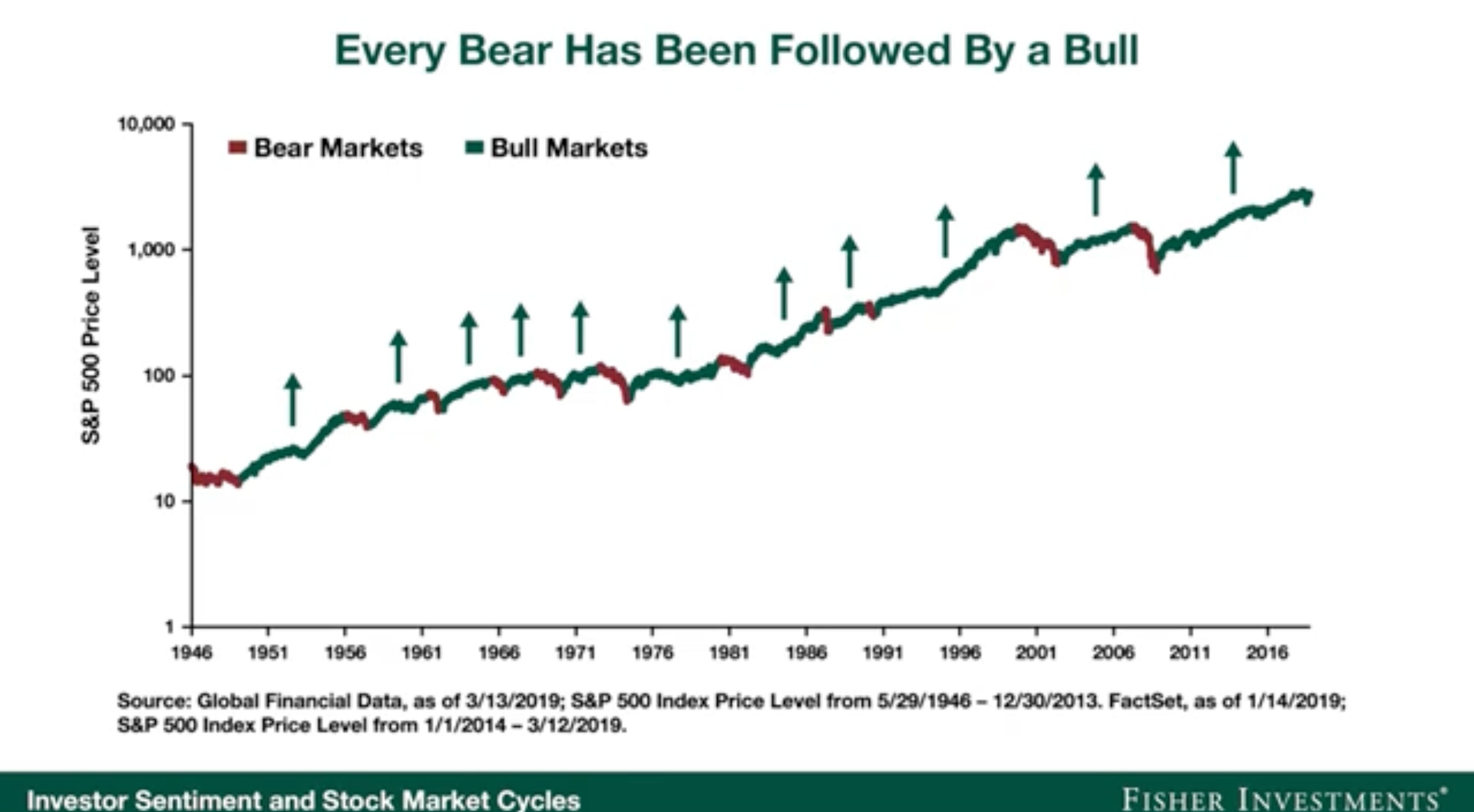
I found a video that talks about investor mood (full video is linked later below, but I'll cover the relevant parts in the text so you don't need to jump away from your reading)
I love macro investors, because they sometimes speak about the market with huge swings at the drop of a needle, as if it was a neurotic grandparent "don't make them see the broken window upstairs or they will have a hissy fit".
The Templeton Curve speaks in terms of Pessimism, Skepticism, Optimism, and Euphoria, and we talk about the market in terms of "Depression" and "Bull (rage)".
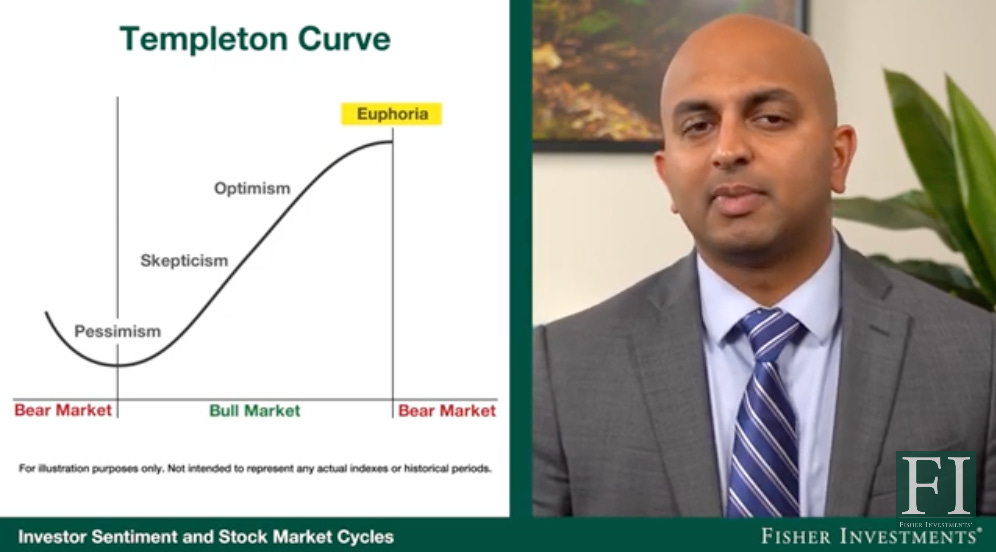
What I find a particularly salient takeaway from this is that these emotions are not the mere byproduct of market cycle stages but a contributing factor preceding each stage.
Source video:
It is extremely unlikely that you are alone with your problem

It is good to take responsibility for our emotions, in the end, they are ours to respond to. However, we can sometimes and an overly individualistic interpretation of the cause of an emotion
An example from my own life is the app Welltory, which tracks and correlates every possible health metric under the sun, made me aware that atmospheric pressure had a strong correlation with my sleep and heart and fitness performance.
Without that bit of data, I tended to go for self-blame a bit too liberally (oh its my fault for not going to bed on time) or blaming an unrelated factor. In the same way, it's important to recognize when something is a suffering that you are very much not alone in.
Without that bit of data, I tended to go for self-blame a bit too liberally (oh its my fault for not going to bed on time) or blaming an unrelated factor. In the same way, it's important to recognize when something is a suffering that you are very much not alone in.
That doesn't change the fact that we have to work to make things better, but it gives a context and allows us to be kinder to ourselves, and perhaps make more reality-based strategical choices, and in some cases it allows us collaborate and share strategies around a shared problem.
Support is a powerful thing.
Flow Club: Virtual Co-working Community (Sponsor)

I am happy to have Flow Club as a sponsor of funfun.email, because I was a user for a long time before that - I was absolutely dependent on Flow Club during the months when I was working on Dawn of The Data developer. Those months were an enormous struggle when it came to attention and energy, and the commitment box and support that Flow Club gives was truly a lifesaver for me.
My productivity has always been many times higher when I am pair-programming, but it is only after my ADHD diagnosis that I realized that I was incidentally practicing a attention hack that has a name - Body doubling (Wikipedia). Since I discovered this general trick, I am like 400% more functional in all aspects of my life that are possible to shoehorn into Body Doubling, which is almost everything.
Flow Club is a community/online service for body doublers. Needless to say, I was all over that shit.
It's such simple idea.
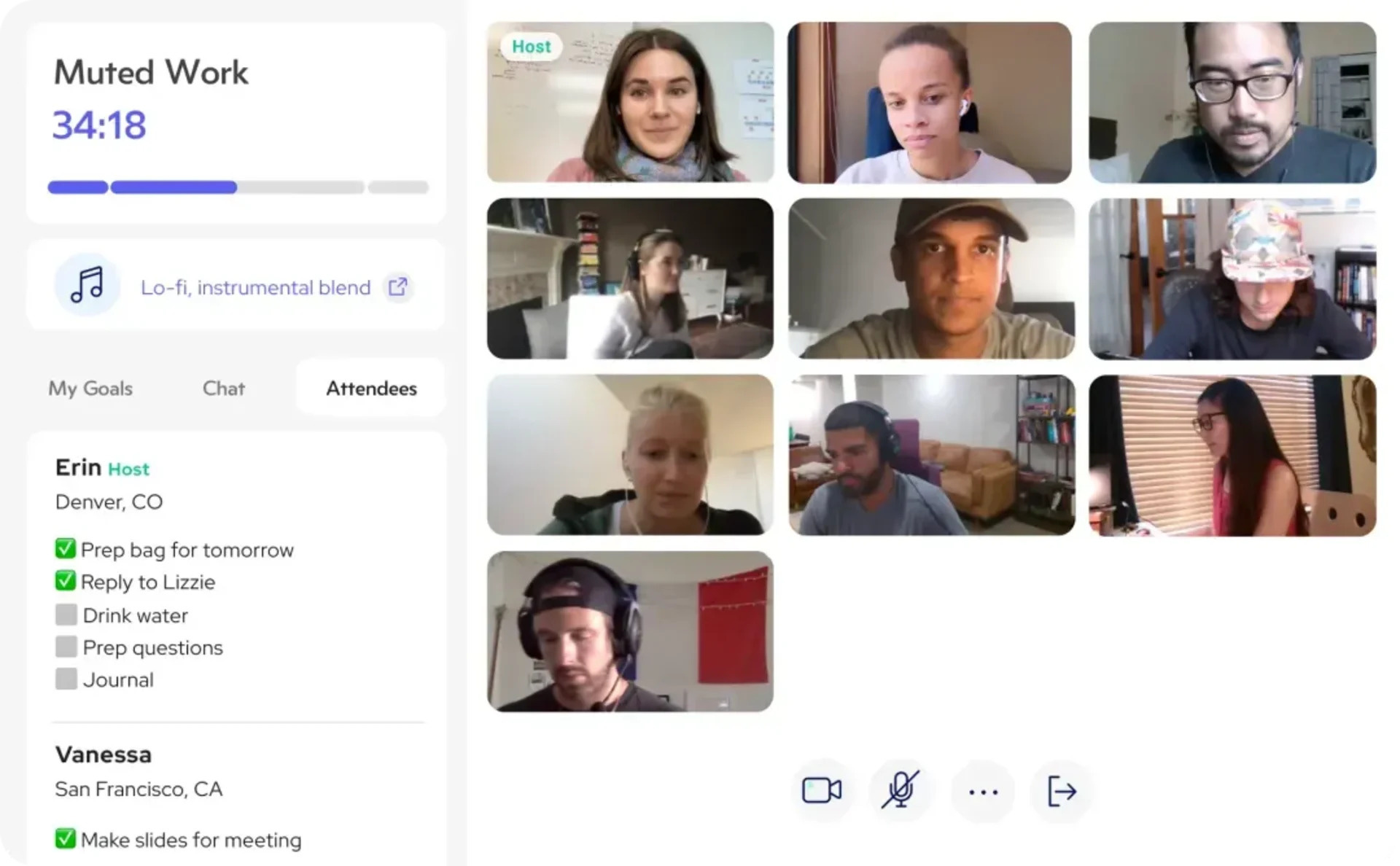
It's really nice to have a dedicated software solution for this with task accountability, confetti animations and pomodoros for this, but the thing I honestly love the most is the amazing vibe of the community.
It's just so godawfully disarming and takes the pressure off and replaces it with a feeling of support. Flow Club is definitely great for getting eat-the-frog kind of work done, but my favorite sessions are frankly the "Start your day" sessions where people show up sometime half-asleep in bathrobes putting down "make some fˆ&@@ing coffee" on their goals list.
If you want to support yourself and support Fun Fun Function at the same time, give Flow Club a whirl using the link fff.dev/flowclub (That link leads to the sessions I host, but you there are many other amazing hosts if you can't make the times I host, or if they are full - Flow Club is really amazing)
That link extends your free trial to 14 days instead of the standard 7 days that the plebeians gets. You also get 30% off if you also use the code MPJ30 at checkout.
(Protip: your monthly cost also drops if you host some sessions in the community, and it's super fun to do - if you start doing that, send me an email at mpj@fff.dev and I'll try to pop in)
Hope to catch you in a flow!
Internal Family System explained through Robots
Finally, and not totally unrelated, one piece of reading that moved and inspired me this week was the fantastic article Building Up To an Internal Family Systems Model on LessWrong, that explains the Internal Family System (IFS) psychotherapy method with machine learning analogies.
It is a spectacular read, both funny and insightful, and hints a lot to what we need to do in the coming decades to build actually smart computers (which hints at that we need to allow robots not only to be traumatized, and likely also offer them therapy).
I hope you have a fantastic week, and as usual, don't be shy to hit reply.
Be a light, not a judge. Be a model, not a critic.