


What has caught my attention this week is, not uncommonly, an etymological quirk - the connection between optimizing and optimism. Both "optimism" and "optimization" derive from the Latin word "optimus" meaning "best" or "excellent" but I think there is something much more interesting in the overlap.
Workplace feedback: “Not positive enough"
On a personal note, a very common conflict in my workplaces has been that I tend not to get swept up in drum-beating positivity, instead feeling awkward as the sole skeptic in the room. At the same time, I have an even greater disdain against people who habitually express negative predictions about the future, justifying their reactionary position by pointing at lines trending downwards towards their prediction of gloom.
This group of people often pose proudly as intellectual realists, when in fact they are just cynics who lack the courage to put their heart on the line.

I've never quite been able to put my finger on what I am in these social situations. Am I some "centrist” floating between positive and negative people, a person that likes to see the shades of grey, nuances of situations? But it always felt distinctly incorrect to refer to myself as “in between” - I don’t feel “balanced” "nuanced" - my volition is often strong and clear, not at all a “negotiator in the middle"
We likely won’t survive, so let’s go!
I often say that I believe in humanity in spite of itself. There are many reasons why we would not make it - Complex organisms tend not to. Empires tend to fall. The dinosaurs were killed by a big rock that they could do nothing to stop, and we could not, at our current state of advancement, do anything different.
Saying something like that often makes me come off as a bit of a downer, but I firmly believe that we can make it. This belief is based on the fact that there are so many (at the time seemingly impossible) problems that we have since solved. Humanity has proven countless Doomsday prophets wrong. I actually don’t believe it’s likely that we will make it - in fact, I believe that the probability is slim, but I also know that we tend to bend such probabilities over the course of history.
This week I've kind of landed on an insight, I am not in between two points, I am a third thing. These are in fact three distinct things - a peculiar triangle of positivity, negativity, and optimism. It's kind of like how Nassim Taleb talks about systems - you have fragile systems on one hand, and then on the other side you have unmovable solid systems. But then he discovers that actually, the opposite of fragile isn't solid - it's antifragile (wikipedia.org/Antifragility).
I started out this chronicle trying to find a word for what I am, but I realize that there already is: Optimist. I have just been confused about it my entire life because there are so many people who say they're optimists but who are actually more… positivists? Eh, Not quite right since it has an established meaning in philosophy (logical positivism) which is quite different from what I’m trying to get at… maybe just sunshine pushers?
The Subtle Language of Optimism
The confusion is so subtle that it is fascinating - it’s commonplace to say"oh, I'm an optimist" or "he's a pessimist”, or "oh that feedback is very positive" or "that is very negative commentary" - alluding that these opposites, but in most other situations, positive and negative is a mathematical or relative term - you have a baseline, and whatever is above that is positive, whatever is below that is negative.
What’s actually happening with people when they say they are "optimists" (or “pessimists” for that matter) - they're actually something more like "energyists" in the sense that they seek to perpetuate whatever energy is going on because that's the path of least resistance for them. This can be expressed as avoiding work by rejecting new ideas, or by perpetuating project momentum with cheer, a phenomenon that is very common if you hold stock in a company in a hype cycle.
What is funny and interesting is that I never hear people request "give me some optimistic feedback". I suspect the reason is that this could be interpreted as an implication that this might not work, and instead we request “constructive” feedback (which I think is a term that, compared to real optimism, will ever so subtly bias away from challenging the current approach too much).
The Three Perspectives: Our World in Data
What prompted this inspiration was an interesting article on Our World in Data, written by Max Roser. It talks about maternal deaths as an example of perspective shifting, and how many diverse perspectives can be extremely true at the same time - the title is The world is awful. The world is much better. The world can be much better. (https://ourworldindata.org/much-better-awful-can-be-better)
It’s a fantastic article that is condensed neatly into this gorgeously dense illustration:
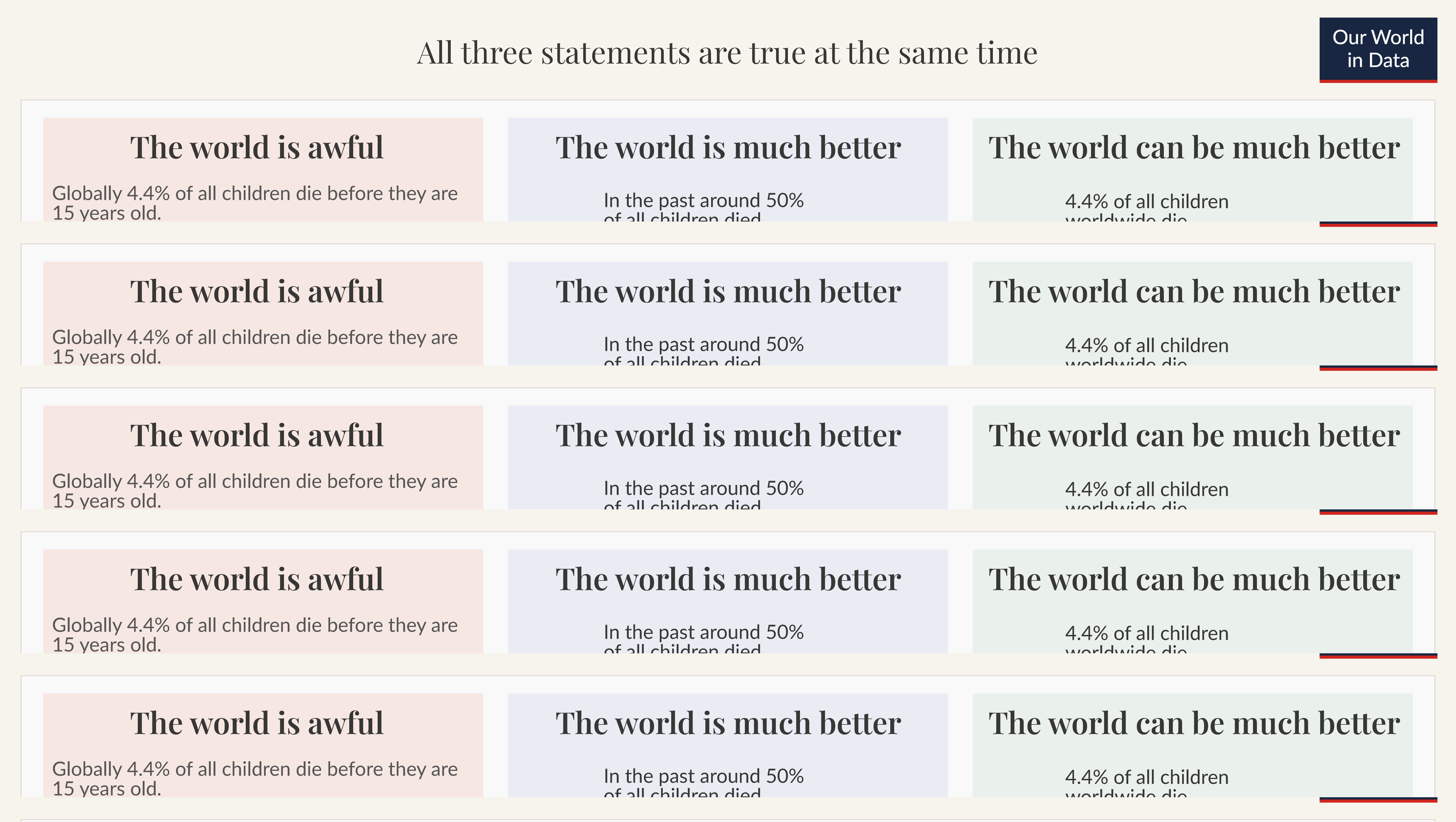
The article doesn’t use the terms, but I think the above illustration perfectly captures the pessimistic, the positive, and the optimistic. Roser talks about how crucial it is that all these three points are true at the same time, and I think it elegantly shows how optimism isn't just about being hopeful, but about holding multiple truths simultaneously - the reality of current problems, the evidence of past progress, and the possibility of future improvement.
I want to stress here that I am not arguing that these are different strategies or personalities, I am saying that all three are necessary components in a triad of reasoning required for progress.
You have to first be negative and be willing to truly see how severe the problem is, then how bad the problem actually was, which puts it in perspective, showing that we’re actually better off than we thought, which also implies that we can improve it even further, enabling us to verify that an optimistic outlook is genuinely plausible, that the problem is optimizable.
No, this is not a "different personalities" thing
To be clear here, I am not saying that “we need all three people”, I am postulating that in order to be a good thinker, you need to keep all three modalities in your head, you cannot think clearly if you slant into too much positivity or negativity, or even if you skip them as steps and rushing quickly into uninformed optimism (i.e. not considering whether it is within our particular power to optimize this particular problem)
Furthermore, you’re going to get into perpetual, unproductive fights with others if you’re hardlining one of these modalities. If you’re being principally positive, you’re going to be fighting the principally pessimistic without having a path to reach common ground.
Principled Negativity: Cynicism masquerading as realism.
Principled Positivity: Blind cheerleading that ignores problems.
Uninformed Optimism: Premature optimism that lacks proper grounding through the negative and positive observations described in the maternal death example.
True Optimism: The courage to see both the negative and the positive in order to create an informed belief that improvements can be made.
Why a simple plot can be so motivating
I want to pull back to a really concrete realization, about that little habit tracker from an earlier chronicle, the one that wasn’t really a habit tracker at all, yet I found worked better than anything I’ve ever tried before - it's just a time series of good behaviour markers:

There is no judgment, no streaks, no failure. It's pure observation leading to improvement, and I think that I accidentally stumbled on creating something that exemplifies optimism versus principled positivity.
The positivity approach is the classic habit streak tracker, that "don't break the chain" thing. Which, by the way, Jerry Seinfeld has been interviewed about many times and he has been clear that it’s something he has been very misunderstood on.
Seinfeld expressed a statement around “do something sort of every day if you want to become very good at it" which was then somehow bastardized into an entire "don't miss a day in your streak" ideology which Seinfeld actually never expressed.

Bright deception: Enforcing Success
The problem with the streak-oriented mentality is that it assumes and focuses on success, and treats any break as a “failure”, as “incorrect”, as “bad”. Streak mechanics gives an energy to be sure, but leads to a massive amount of disappointments and lack of motivation if the stream is broken. That's why people who have this approach, need to be super momentum-oriented, to the point of being in denial.
You have to be very forgiving with your streaks because it's so devastating to break the streak that you can be like "yeah, I went down the corner store so now I can get a habit checkmark for my daily walk” or “hmmm the chicken/bacon salad was kind of a healthy meal I guess”. When you are targeting a specific result you’re likely to see what you want to see, instead of what truly is.
Dark deception: Harsh self-discipline
On the other hand, we can also motivate ourselves through flagellation. The dark energy with ruthless self-talk about the critical self-monitoring that many of us fall into, where we instead track our failures. It’s less recognized as a valid strategy in cheerful self-improvement circles, but I think it is actually an extremely common strategy and negative self-talk is one of those things that might be underrated in its efficacy.
I just love this contentious video by Struthless, that makes a strongman argument for negative thoughts, talking about how the ultra marathon runner Turia Pitt envisions horrible things in order to scare herself into running faster:
However, just like the positivity case above, the longer you try to sustain negativity strategies like this, the more likely it is to eventually necessitate another brand of self-deception. This is triggered because being failure driven is exhausting - if you are looking at yourself or the organization or the world saying “this is shit, we are shit, we must improve” every observation becomes painful.
Pain can be motivating in bursts, but on a longer scale, it becomes untenable and we start developing strategies to avoid the pain, essentially, make our lives not miserable. 🙂You can either solve this by distracting yourself with other matters (because observation is painful, remember) but you can also take the strategy to take the edge off your negativity-engine by formulating explanations to how certain parts of the problems are not within our power to solve, or philosophies of how we don’t deserve better, that the problem is impossible to solve, not worth it, etc. I.e. abdication of responsibility.
The Third Way: Optimistic Observation
Now, the third approach, just drawing a plotline of the quality that you're working with - that is optimizing. Simply observing and graphing - that's optimism in action - it acknowledges both the ups and downs. The optimism that I am trying to describe here is defined by how it acknowledges both progress and problems at the same time, and crucially also maintains the possibility of improvement through better understanding.
I.e. you're not chasing streaks or flagellating yourself over misses - you're not even in a middle ground between those things. You're in a completely different place, a third place, where you are creating knowledge about your patterns. You are asking "how can this pattern become better?" but you're still very much looking (and choosing to actually see) what the pattern is.
A miniature model for civilization's progress

The habit plot is a little mini universe of how civilization actually makes sustained progress. It's not through relentless positivity or cynical negativity - sometimes they work - but that is mostly because of chance, or because the solution to the problem was blindingly obvious, which is exceedingly rare.
We didn't reduce child mortality from 50% to 4.4% by pretending everything was fine or giving up in despair - we did it through persistent observation, learning, and problem-solving.
Doomsday prophecy is the cheapest type of prophecy
There's this fantastic historical example that perfectly illustrates our positivity-negativity-optimism triangle - the story of Thomas Malthus and his predictions about population growth. In 1798, this guy looks at the data and makes what seems like an absolutely rational prediction: humans are fucked. Like, properly fucked.
His argument was mathematically sound - population grows exponentially, but food production (he thought) could only grow linearly. Therefore, mass starvation was inevitable unless we controlled population growth. It's the perfect example of the "intellectual realist" mindset - taking current trends, extending them forward, and concluding disaster is inevitable.
The core problem Malthus identified was real - feeding a rapidly growing population is a genuine challenge. A pure positivity approach would have just denied the problem existed. But what actually happened? Through a combination of scientific advancement, agricultural innovation, and systematic problem-solving, we dramatically increased our food production capacity.

The Green Revolution, modern farming techniques, better understanding of soil science, genetic improvements in crops - we didn't just solve the problem, we overshot it so much that in many parts of the world, obesity is now a bigger concern than starvation.
What is quite amusing is that we now have a whole new set of doomsday prophets warning about declining birth rates - the same mathematical "realism" that once warned us we'd have too many people is now warning us we'll have too few.
This pattern - identifying real problems, but then assuming they're unsolvable - is what separates cynicism from true optimism. The optimist doesn't deny the severity of the problem or need for strong action (that would be toxic positivity), but also doesn't assume current limitations are permanent. Instead, they look at the problem as something that can be understood, analyzed, and ultimately solved through better knowledge and systematic improvement.
It's the same pattern we see with child mortality today - we can simultaneously acknowledge it's still a massive problem, recognize how far we've come, and work towards the better outcomes we know are possible because some countries have already achieved them.
Positivity stole the credit from optimism

At its heart, this is about a fundamental misunderstanding we have about how to create progress. There's a widespread belief that positivity - that relentless, momentum-driven cheerleading - is what drives progress, but anyone that has come to that conclusion is likely not accounting for survivor bias, because positivity without observation is just luck.
Real progress comes from knowledge creation, and knowledge creation requires something far more demanding than positivity: the courage to see things as they truly are while maintaining an unwavering belief that they can be better. This is what separates the optimist from both the cynic and the positivist. The cynic sees the truth, but concludes nothing can be done. The positivist refuses to see the truth for fear of losing momentum. But the optimist? The optimist looks reality straight in the eye and says "Okay, now how do we make this better?"
True optimism requires perfect courage - the courage to accept what is while working toward what could be. It's like a negotiation - if you can't walk away from the table, you're not really negotiating. Similarly, if you can't accept the full truth of a situation, you're not really optimizing. You're just performing.

True progress comes from a bleeding heart
Perhaps most cynics were originally principled positivists that were hurt, betrayed or disappointed - someone who once relied on blind faith and momentum, only to have reality break their stride.
But a true optimist is inoculated from becoming a cynic, because optimism isn't about faith or momentum - it's about the practiced ability to face reality while maintaining the conviction that improvement is possible through better understanding.
It's how we've solved countless "impossible" problems before, and it's how we'll solve the ones we face today -eschewing denial and despair, and putting our hearts on the line through clear-eyed observation and methodical, intelligent action.
As always, stay curious 🧐🐒
Mattias Petter Johansson