


It is highly possible that news has reached you the .io top level domain (TLD) is going away.
This story is actually about another story but long story short is that The United Kingdom is relinquishing control over The British Indian Ocean Territories (Article: UK will give sovereignty of Chagos Islands to Mauritius).
All that means that the country ceases to exist, and thus the .io TLD goes away as well.
So, congratulations, Mauritius, on your new island(s)! 🎉
"Well this is a bit of a pickle"
A country and it's TLD being disbanded happens to be a bit of a pickle for many tech companies (and many more crypto scams), who have adopted the domain because of it's input/output connotations, rather than having anything to do with the Indian Ocean territories.
I’m sure many that use the .io domain had no idea about the connection. Not just for domains one owns yourself, but also ones you use by extension - there is a lot of github.io pages (the domain github uses to provide free subdomains for hosting github pages)
I can't blame them - honestly, I myself use mpj.me and I had not thought about the fact that it is TLD for Montenegro (which is related to the later Balkan part of this story). As a Swede, I've also owned many .nu domains in my day, a TLD that is is one big shenanigan featured in this story.

Digital "Anitya"
I do love learning about TLD shenanigans. I think it is because they remind me that nothing in life is stable. TLDs seem so robust, like something that transcends the physical in permanence, so when they go away, it is like digital anitya - a common buddhist term which means "Impermanence" in Sanskrit.
It gives me a weirdly nice and liberating feeling that the concept of a country and its domain just goes away. I think it’s for the same reason that I find pleasure in the fact that Limnic Eruption exists.
If you’re unfamiliar, Limnic Eruption when big carbon dioxide pockets at the bottom of a big lake gets dislodged by small earthquakes, and when the bubble comes up to the surface it pushes all the oxygen out of its way for a few kilometers and everything that was strolling around the vicinity of the lake suffocates. It is one of the most rare natural disasters that exists - in recent history, this phenomenon has been observed twice.

The first recorded limnic eruption occurred in Cameroon at Lake Monoun in 1984, causing asphyxiation and death of 37 people living nearby. A second, deadlier eruption happened at neighboring Lake Nyos in 1986, releasing over 80 million m3 of CO2, killing around 1,700 people and 3,000 livestock, again by asphyxiation.
While technically horrible, Limnic Eruption reminds us that the universe is absolutely neutral and owes us nothing, and the fact that ANYTHING works at all is wonderful.
But I also love TLD stories because of the same reasons I like heist movies - TLDs is an area where a lot of (really clever) shadiness has been going on, and people often get away with it. Clever cookies in the early days of the Internet made deals with governments to run their TLDs before it was widely known how much money there was in running a registrar.
In the .io case, this cookie was Paul Kane (now CEO of CommunityDNS), and he got the TLD in 1997, and operated it until April 2017, he sold the Internet Computer Bureau holding company to Afilias for US$70 million in cash.
In July 2021, the Chagos Refugees Group UK (yes, the same island mentioned at the beginning of this chronicle - that is now under control of Mauritius) submitted a complaint to the Irish government against Paul Kane and Afilias, seeking repatriation of the .io domain, and payment of back royalties from the $7 m per year in revenue generated by the domain.
A detail I noticed while looking into this was that the The Chagos Refugees group co-filed this complaint with the Crypto Currency Resolution Trust, which is a crypto scam victim fund that sues for damages because .IO was a popular domain for crypto scammers to use, because the British Indian Ocean Territory lacks a financial crises unit, and can’t really prosecute any crime committed on .io.
I also learned that said Paul Kane was selected to safeguard one of seven keys to restart the internet in case of a catastrophic event.
From the article: “In the event of a security breach, Paul may be required to travel to a secure location in the US where he will meet five other key holders, to recover the master signing key.”
In light of all this, I propose that we henceforth refer to Kane as “Domain Name Saruman”.
How to scam an small pacific island by leveraging a Swedish foundation
For Swedes, the story of the .nu domain is rather well know. The .nu domain, which corresponds to Niue, a small island in the Pacific with a population of 1681, has been the subject of a long-standing legal dispute over its control and the financial benefits associated with it.
In the 1990s, Niue’s government entered into an agreement with American businessman Bill Semich (Domain Name Sméagol?), who helped register and manage the “.nu” domain.
The domain, which coincidentally means “now” in Scandinavian languages, became particularly popular in countries like Sweden, Denmark, and the Netherlands.
Semich’s foundation, IUSN, promised to provide Niue with free internet access in exchange for control over the domain. However, over time, Niue realized that they were missing out on substantial revenue from domain registrations, which could have supported the island’s economy.
What is especially absurd with this story s that Niue still doesn’t have control over it’s domain - in 2013, the management of .nu was transferred to the Swedish Internet Foundation (Internetstiftelsen), sparking further dissatisfaction in Niue.
The Niuean government has since been fighting to regain control of the domain, arguing that they were misled and that the agreement was unfair. They even pursued legal action in Swedish courts, seeking damages for lost revenue estimated at around $30 million.
However, in 2020, the Stockholm District Court dismissed their case because a foundation cannot be liable to damages, it seems), and Niue was ordered to cover legal costs. Despite this setback, Niue remains determined to reclaim the domain and continues to appeal for redelegation through ICANN.
Can I just say: Yarrrrr. 🏴☠️

From .yu to .me
BUT my favorite story is that of .yu, because it has a bit of a different turn. In 1989, Borka Jerman-Blažič (Domain Name Gandalf?) and her team in Ljubljana began working to connect Yugoslavia to the internet (it is a bit abstracted away nowadays, but during the early days of internet, a country effectively needed a TLD to connect to the internet.
At this time, Jerman-Blažič registered the .yu country code top-level domain (ccTLD) for Yugoslavia, a story she tells in the wonderfully internet-retro documentary from yu to me:
I am really glad that the .io debacle made me find the above documentary, as it is a wonderful piece of edge history about the Internet, and a really cool portrait of Borka. Her story is a very pure example of "ask for forgiveness, not permission" where she basically said to herself "well someone needs to pull internet into this country" and did it.
Connecting a country to the internet is a project that Borka basically managed on her own initiaive, and two years later, in November 1991, Yugoslavia was connected to the internet.
Due to the early nature of things at this point, we have many stories about people like Borka - the first person to realize that this was needed, and they pulled Internet in. Some were more entrepreneurial than others, and I think Borkas story was unusually ego-less and she is obviously a personality more driven by "this needs to occur" than personal financial gain or glory.
Anyway - Yugoslavia was unfortunately only peacefully connected for less than a year. After that, things got messy.
It is important to understand that during the two years it took Borka to actually use the TLD to actually connect Yugoslavia to the Internet, Yugoslavia crumbled quite a bit as a country, and in June 1991, Slovenia declared independence from Yugoslavia.
Already in February the following year, Slovenia manages to get international recognition and becomes a member of the UN. As you can see, it is a lot easier to pull off anything in the nineties.
The Slovenian government created the Academic and Research Network of Slovenia (ARNES) to manage its new .si domain. However, while they were waiting for the .si domain to become active, they needed access to the internet, so ARNES members broke into Jerman-Blažič's lab, copied the .yu domain software and data, and cut off the line connecting her computers to the internet.
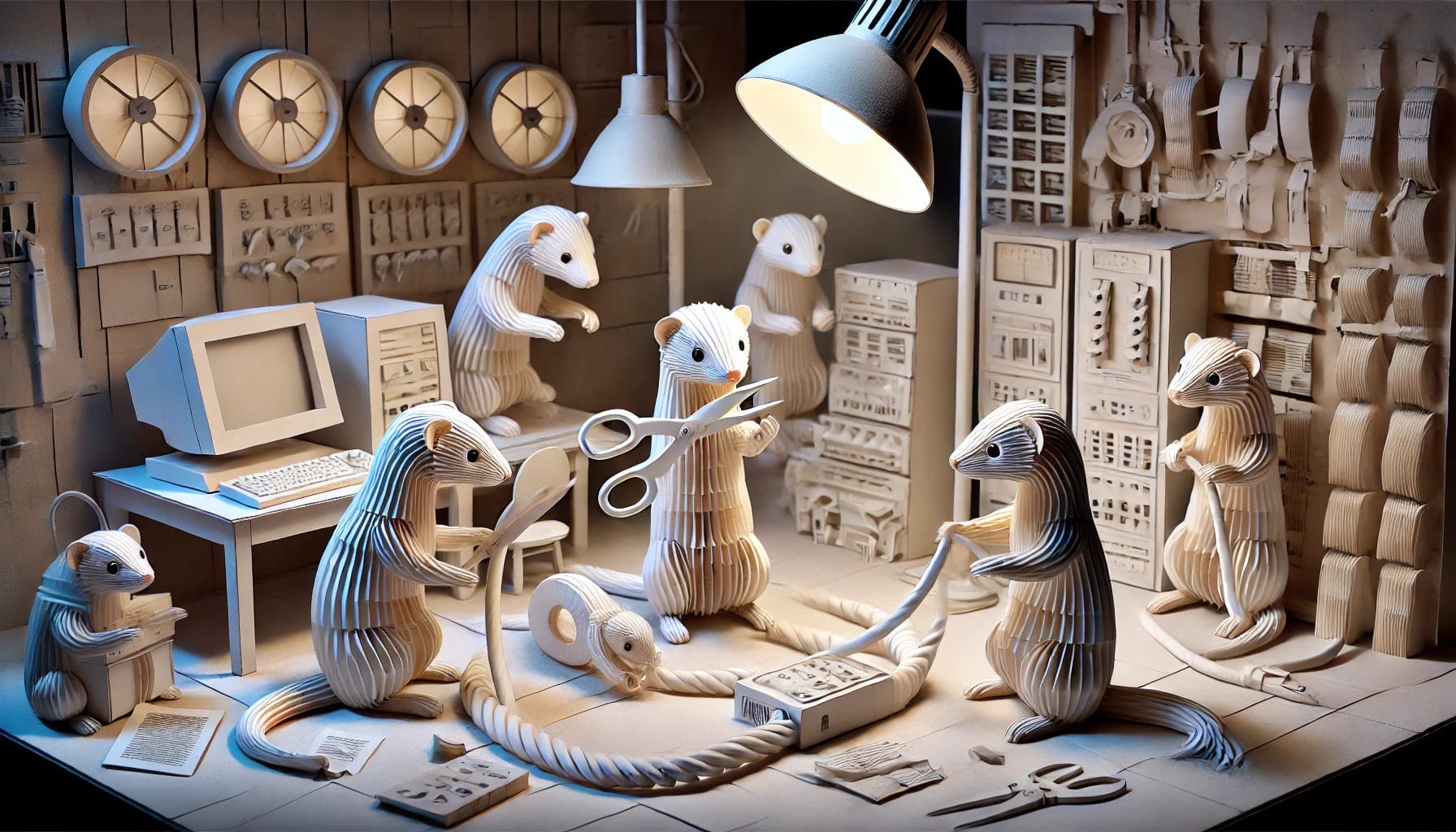
From How does one connect a country to the internet?:
“During one weekend in July 1992, the people who were later employed by ARNES broke into my laboratory and, using scissors, cut off the line connecting my computers to the switch located in the cellar of the institute, then copied the zone file for .yu.
They did know how to run the domain server,” she said. "Though they only used the network for email, ARNES secretly kept .yu running for the next two years, ignoring requests from a rival group of scientists in Serbia who needed the domain for their work.”
So yeah, in the nineties, (even if you didn't know how to properly configure DNS), you could break into a lab and physically heist a TLD by cutting a network cable with a pair of scissors and nabbing the zone file.
All of .yu went dark on March 30, 2010, but after that it was acquired by the museum of Yugoslav History, similar to the Museum of Modern Art in New York's acquisition of the "@" symbol. The Museum of Yugoslav History views the .yu domain as its first virtual artifact.
Be a scoundrel
Early internet stories have so many stories of people who did things that they weren't supposed to (not not supposed to, there were NO rules at the time) and weird and unpredictable things occurred.
I don't mean to glorify any of these as examples of how things should go, but hey, they did, and it's cool, and the internet did end up existing!
Sometimes, its good to play it safe and be amicable and polite, and sometimes, there is treasure to be found, and adventure to be had, for the scallywags, rascals and scoundrels.
By all means, try to play nice, but if things are frustrating for you this week, even though you're doing all the things right and by the book, then maybe, just maybe - consider if instead it might be appropriate with some shenanigans.
Beautiful News
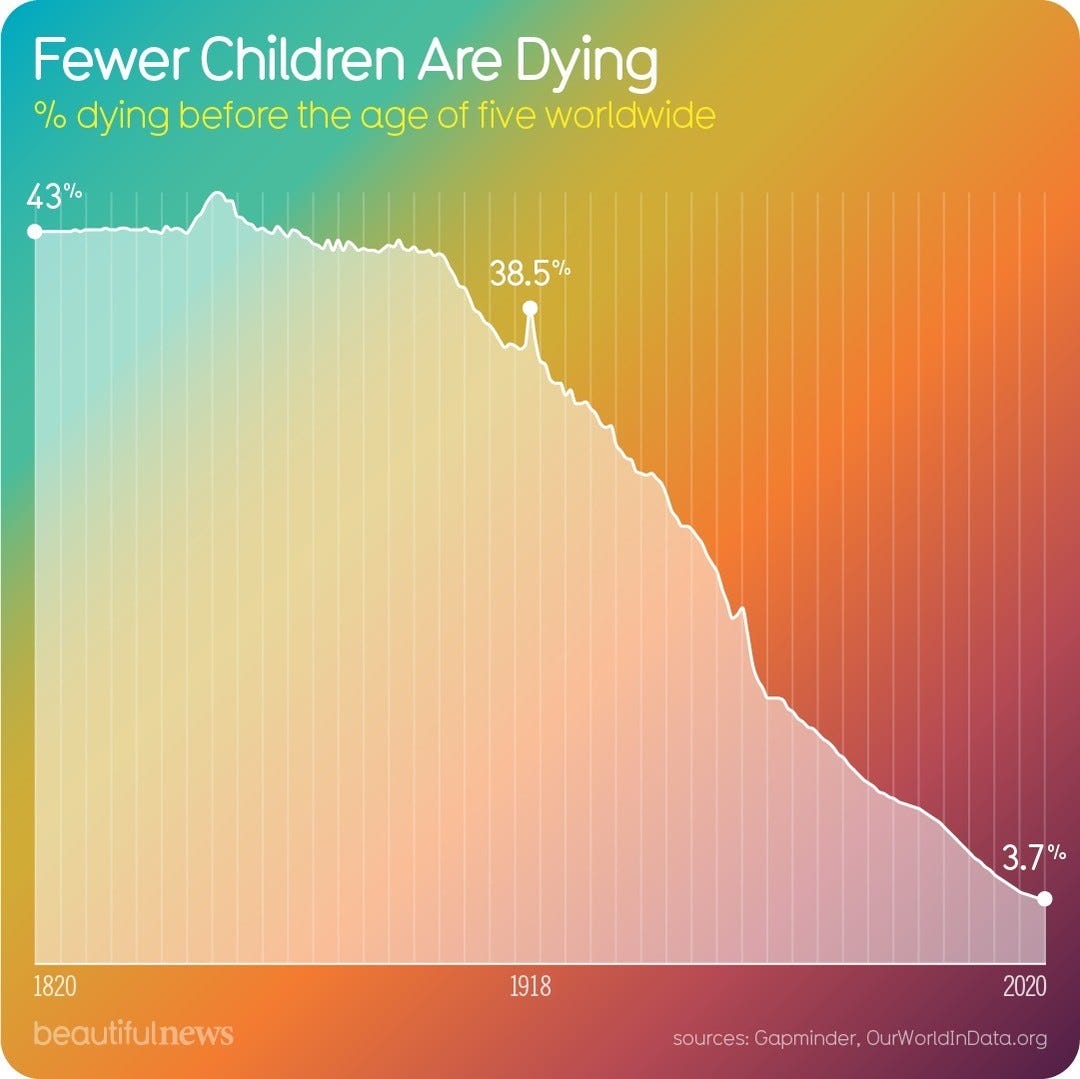
Oh, and one final thing - I just now discovered Beautifulnews by Information is Beautiful. This is great, especially since it redefines the usage of the word "news" as "news to you maybe" instead of the colloquial "recent sensational anecdote".
Lovely, simple:
Have a great week, and stay curious